
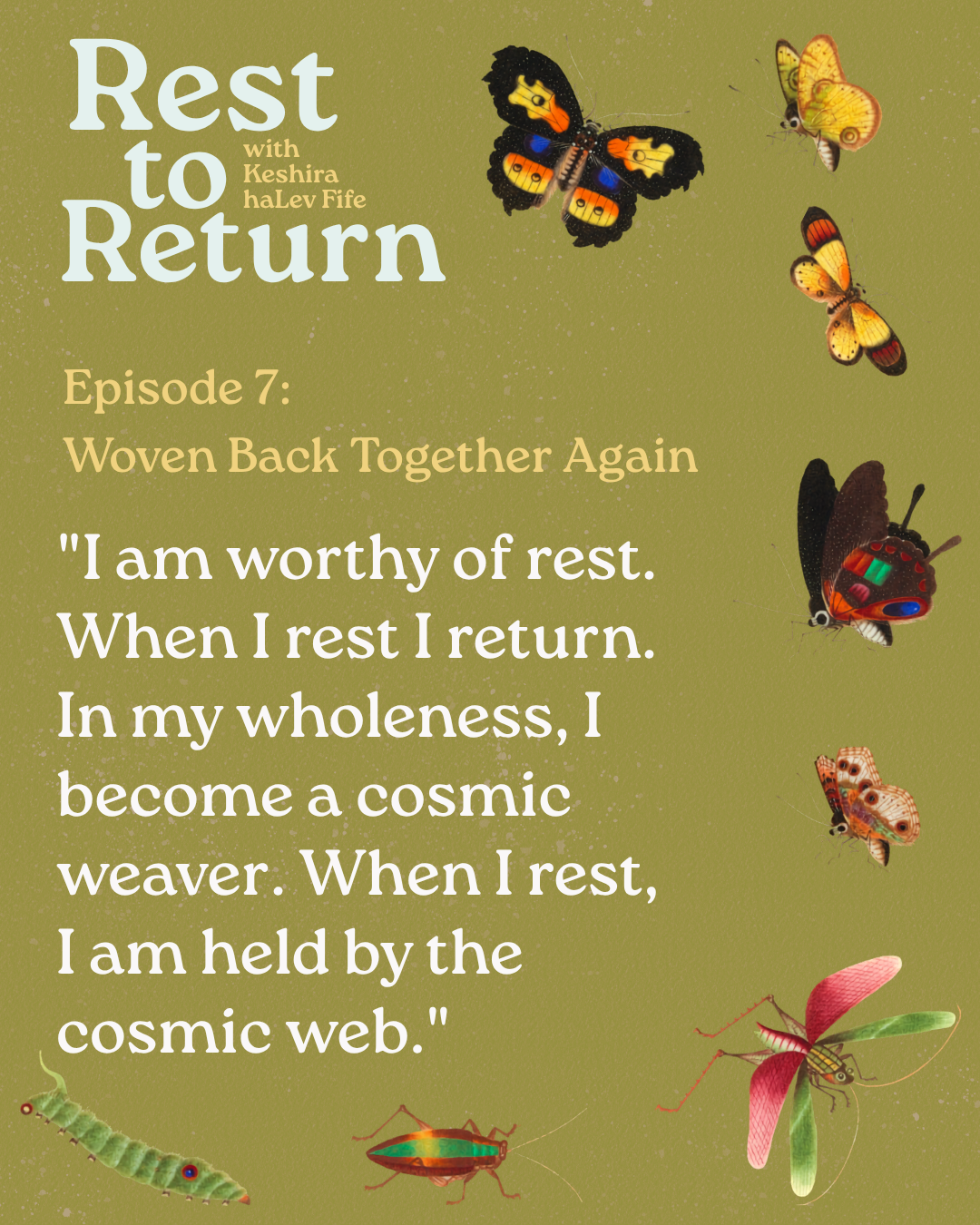
EPISODE 7: Woven Back Together Again
Show Notes
Lecha Dodi is the song that ends Kabbalat Shabbat (the service that helps us transition into Shabbat) before we move into the Ma’ariv prayer service.
The idea that Creator finished creation on the seventh day comes from Genesis 2:2.
Tranquility, satisfaction, calm, and quiet being created on the seventh day comes from Genesis Rabbah 10:9.
The idea of creating change that’s “slow, deep, and irreversible” comes from artist and activist Ricardo Levins Morales.
I learned the mussar practice of clarifying our ratzon by asking “what do I want? What do I really want?” from Rabbi David Jaffe of Kirva. You can learn more in Chapter 1 of his book, Changing the World from the Inside Out: A Jewish Approach to Personal and Social Change.
This quote has been misattributed to Courtney Carver. It is instead referenced by Carver in her book, Gentle: Rest More, Stress Less and Live the Life You Actually You Want. The quotation itself comes from Psychologist Nicola Jane Hobbs who teaches, “Instead of asking, 'Have I worked hard enough to deserve rest?' ask, 'Have I rested enough to do my most loving, meaningful work?'”
Enjoy the live version of Lay it Down, Let it Go here.
This episode is brought to you by the Institute for Jewish Spirituality. Rest to Return exists because we believe slowing down is a spiritual act. IJS believes that too. For over two decades, IJS has been helping people go deeper through Jewish mindfulness, meditation, contemplative prayer, sacred text study, and embodied practice. Their offerings range from online courses and silent retreats to immersive cohort programs for seekers of all experience levels, clergy, and spiritual leaders who are ready to live and lead from a more grounded place. Kohenet Keshira haLev Fife is part of IJS’s core faculty, and the wisdom you'll hear in this series is very much in that spirit. If this podcast is stirring something in you, IJS is a place to go further. Explore their programs, and more ways to learn and practice with Keshira, at jewishspirituality.org, including:
View the latest offerings from IJS in our program catalog
Join Keshira and others on retreat this August: Returning Anew
Learn more about Shevet, IJS's community for younger adults (20s-30s)
IJS has several online free practices with Keshira and our other faculty including our live Daily Sit, our weekly Shevet Sit for younger adults (under 40), and monthly Affinity Sits for Jews of Color, LGBTQ+, and individuals with disabilities. Click here for more information.
Join our mailing list to be notified about our upcoming fall courses, including Keshira's Earth, Moon, Mindfulness year-long class.
-
Each time I lead Kabbalat Shabbat, I invite people into a reflective practice before we sing Lecha Dodi.
I do this for the sake of helping them slow down and process their week, resting in reflection for a few moments.
I begin by asking people to remember back to last motzei Shabbat, last Saturday night: where were you? Who were you with?
And then: how did the week start for you? What did you do on Sunday?
On Monday, what did you do that you enjoyed?
what did you learn? On Tuesday
On Wednesday, who did you help? Who helped you?
Yesterday, who brightened your day? Whose day did you brighten?
And today - Friday - what did you do for the first time? Or what did you do for the last time?
We then take a moment to bring all of those memories together, braiding them into the week that we’re about to let go.
We pause in gratitude, in the awareness of what we want to release, in the highs and lows that will soon be behind us.
That moment creates a pathway for us to return to ourselves, remembering who we are when we rest.
And then we set it all down and move into sacred time…
Welcome to Rest to Return, a podcast for a restless world. I’m Kohenet Keshira haLev Fife and I’m your host. This series is rooted in Shabbat, an ancient Jewish practice that teaches us how to belong to time. Here, rest is a sacred rhythm woven into who we are.
We conclude by gathering around a single question: Who do we become when we rest?
This is an invitation to return. Sacred time starts now.
Just as in Jewish cycles of time, where six days are followed by rest and integration on Shabbat, our journey through six episodes now culminates in a time for the same.
The Torah teaches, in the book of Breishit (2:2):
וַיְכַ֤ל אֱלֹהִים֙ בַּיּ֣וֹם הַשְּׁבִיעִ֔י מְלַאכְתּ֖וֹ אֲשֶׁ֣ר עָשָׂ֑ה וַיִּשְׁבֹּת֙ בַּיּ֣וֹם הַשְּׁבִיעִ֔י מִכׇּל־מְלַאכְתּ֖וֹ אֲשֶׁ֥ר עָשָֽׂה׃
On the seventh day, Creator finished the work that had been undertaken: They ceased on the seventh day from doing any of the work.
This is the origin text for the concept of Shabbat and the imperative to cease work and to rest. However, we rarely ever focus on the part of the verse which indicates that “on the seventh day, Creator finished the work of creation.” This means that as evening fell and the seventh day began, the Divine was still creating!
What was left unfinished? According to midrash (Genesis Rabbah 10:9), on the seventh day, Divine Creation formed tranquility, satisfaction, calm, and quiet. In short, the Divine created rest itself. The creation of rest, of ease, of equanimity was the crowning work of creation. Only then, did the Creator rest.
So too, we do the same. The act of making challah on Shabbat is an embodied form of integration which weaves separateness into one and then, by baking, brings those strands to a state of interconnectedness that cannot be undone. This is our time to braid the strands together - new insights woven with inner knowing, woven with ancestral wisdom - and then we set it aside to proof before putting it into the oven.
Shabbat is much the same for us - this is when we rest and integrate, bringing ourselves back together, allowing the parts of us that have gone astray to gently return. When we allow time to slowly integrate, we return to wholeness. Just as baking the challah creates a single loaf from disparate strands, Shabbat allows us to come back to ourselves, integrating in ways that are, in the words of Ricardo Levins Morales, “slow, deep, and irreversible.”
Through the practice of rest, we slow down enough to notice - thoughts, feelings, sensations arising in real time. Having set other things aside, we have mental and emotional space to become curious about the experiences we’re having, and to even let ourselves wonder. Before long, we might find ourselves in self-reflection or in day dreaming; either way, the opportunity to follow that energy creates space for us to make sense of ourselves and of the world around us. This is a form of remembering, or re-membering.
In essence, this time allows us to return to ourselves, to embrace the parts that have been missing, to become whole again, and to know our own holiness.
Let’s do some of that integration work together now.
As we move into this extended time of reflection, you might bring yourself to a restful posture, noting how you feel in this moment. If the breath is accessible, you might take a few moments to notice its depth and quality. No need to change anything, just an invitation to notice what’s here.
You might also check in with your body, where there are places of ease or constriction. Take a few moments to notice where your body connects with your seat, or the bed, or the floor, and attune to the way that the earth and gravity are holding you, faithfully.
You might check in with yourself and ask, are there any adjustments you could make toward greater comfort or ease, even just 10%?
From this place, we settle in to rest, remember and integrate:
We began with the question: What do we need in order to sustain our sacred purpose?
We explored the ways in which slowing our bodies and coming to stillness invites healing and integration.
Take a moment now to become aware of yourself- are you a person of the book? Of the body? Of the earth? On the move?
What do you notice in this present moment of stillness? What parts of you are yearning to be healed, or held? You might place a gentle hand on your body to bring some compassionate energy.
This feeling of rest, or relief, this is your birthright. You are worthy of rest simply because you are. Not because of the work that you’ve done, not because of the work that you’ll do. Simply because you are, by nature, a creative person, deserving of rest. Just rest…”
Next, we delved into the question of: What is my sacred purpose?
You are Divinely inspired as a creator and you have agency in being part of weaving Olam haBah, the world we deserve and desire.
Ask yourself once again now: what do I want? What do I really want? You might speak aloud or focus on your ratzon, the internal motivation that guides your choices and actions. “If it’s helpful…yearning.”
Take a moment to rest in the awareness that you are woven into Olam haBah, sometimes as an expression of your ratzon, sometimes as one being held by the web.
And then to ask yourself, in the words of Courtney Carver, have I rested enough to do my most loving and meaningful work?”
What would it take to answer this question with a confident “yes”?
How much rest? In what form? When?
Then we asked, how do we know when to work and when to rest?
Can you sense in your body now, where are you? What season is it? How are the elements showing up? And when are you? What season is it? What time of day is it?
Can you allow this awareness to intermingle with cycles of sun and moon…or the rhythm of the week and Shabbat?
What is it time to do now?
What would it mean to rest when you need to? What arises when you even consider it?
The choices that you make toward restfulness can re-pattern you, and those around you, with relationship to multi-layered time, reminding us that we are worthy of rest, anytime we need it.
How does that feel?
We asked the question: where do we find permission to rest?
Are you able to give it to yourself? Are you able to give to another? Could you receive it, if it were offered in a genuine way?
Whose presence might help you rest more deeply? Can you imagine a friend, or a family member, or an ancestor with whom you could fully rest?
When would you rest? On Shabbat? During another time of the week? Both?
This brings us to the question: What is sacred time?
What are the qualities of sacred time? What does it feel like to immerse in it?
What would it mean to adopt restfulness - Shabbat consciousness - as you move through time?
How might you embrace restful activities, allowing yourself to release what’s not yours to do?
Just notice if there’s relief or constriction, if frenzied thoughts are arising, or if your mind is settling. No right or wrong, just what’s happening.
What feels most resonant to you? How do you want to relate to Shabbat? How do you want to relate to rest?
Pause to notice whether the response that arose was conscious or whether it was habituated; no shame, not even a need to think a different thought. Just an invitation and permission to revise, or to go deeper.
What’s here now, as you consider your relationship to sacredness and sacred time?
No need to be perfect, to strive; try to allow yourself to just rest in the awareness of the sacred.
Inside you. Around you. Between you and every other sacred being you encounter.
With this, we arrive to our 6th question: what makes time sacred?
You do. We do. By being part of the web of connection, by upholding the construct of sacredness, by giving ourselves rest as a holy act.
That holiness exists at the intersection of the divine spark and our willingness to know it as sacred and to protect it, together.
It’s in the concerts, it’s in the weddings, it’s in the sports arenas, and in the art studio.
Where do you make sacredness with others?
This is how we weave Olam haBah, through this combination of agency and humility.
Where does that sit within you? What is your piece of the puzzle? What letter are you? What words are you part of? And what worlds do you create with those words?
It is OK to rest. Not as preparation for more work. Not in service of greater productivity.
But as an end in itself. As you rest here now, you are returning to the truest version of yourself.
May you allow yourself to set down what you can, so that you can hold the awareness of your own preciousness, of your own infinite loveability and worth.
As you allow yourself to rest here, we integrate, bringing together the strands, as if in a challah. As the music plays, take this time to allow the strands to combine and rise, becoming inseparable as they bake, preparing to nourish us.
We add the finishing touches with a sprinkle of magic - cinnamon sugar, or poppy seeds, or just a holy exhale…and with an incantation, which you might like to repeat or receive:
I am worthy of rest.
When I rest I return.
In my wholeness, I become a cosmic weaver.
When I rest, I am held by the cosmic web.
Lay it down. Let it go. The world will keep worlding. Let yourself rest.
Gratitude to Lippman Kanfer Foundation for Living Torah for making Rest to Return possible. Rest to Return is a production of the Institute for the Next Jewish Future and part of the family of podcasts of Judaism Unbound. Hosted by Keshira haLev Fife, directed by Joey Taylor, produced at Monastery Studios, sound engineering by Justin Watson, original music by Keshira haLev Fife, arrangements by Ric Hordinski and art by Katie Kaestner.