
EPISODE 6: Making Time Sacred
Show Notes
The concept that each of us is created b’tzelem Elohim, in the Divine Image, comes from Genesis 1:27.
The first person who I heard crystalise the idea that we need to reach REM sleep in order to dream was Rev Dr Tony Lim, during a gathering of Spiritual Innovators at the Fetzer Institute.
The idea that dreaming is one-sixtieth of prophecy comes from Berakhot 57b.
The concept of the Jubilee can be found in Leviticus 25:8-16.
I first learned about Soli-lunar time from Seasons of our Joy: A Modern Guide to the Jewish Holidays by Reb Arthur Waskow z”l.
Geoffrey Chaucer was a writer and poet who lived in the 1300s; he was best known for having written The Canterbury Tales.
I learned “Who Make the Future?” at Let My People Sing; the song is by Abigail Bengson of the Bengsons.
Enjoy the live version of Lay it Down, Let it Go here.
This episode is brought to you by the Institute for Jewish Spirituality. Rest to Return exists because we believe slowing down is a spiritual act. IJS believes that too. For over two decades, IJS has been helping people go deeper through Jewish mindfulness, meditation, contemplative prayer, sacred text study, and embodied practice. Their offerings range from online courses and silent retreats to immersive cohort programs for seekers of all experience levels, clergy, and spiritual leaders who are ready to live and lead from a more grounded place. Kohenet Keshira haLev Fife is part of IJS’s core faculty, and the wisdom you'll hear in this series is very much in that spirit. If this podcast is stirring something in you, IJS is a place to go further. Explore their programs, and more ways to learn and practice with Keshira, at jewishspirituality.org, including:
View the latest offerings from IJS in our program catalog
Join Keshira and others on retreat this August: Returning Anew
Learn more about Shevet, IJS's community for younger adults (20s-30s)
IJS has several online free practices with Keshira and our other faculty including our live Daily Sit, our weekly Shevet Sit for younger adults (under 40), and monthly Affinity Sits for Jews of Color, LGBTQ+, and individuals with disabilities. Click here for more information.
Join our mailing list to be notified about our upcoming fall courses, including Keshira's Earth, Moon, Mindfulness year-long class.
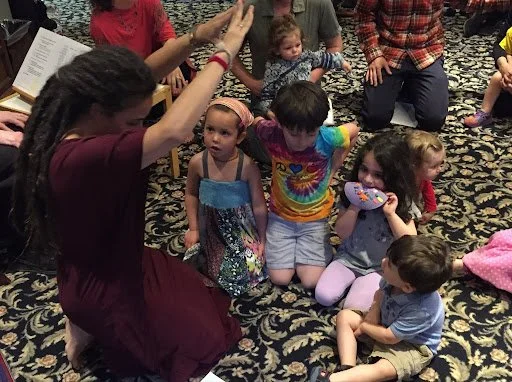
Here’s a photo of us “playing shul” in Pittsburgh.
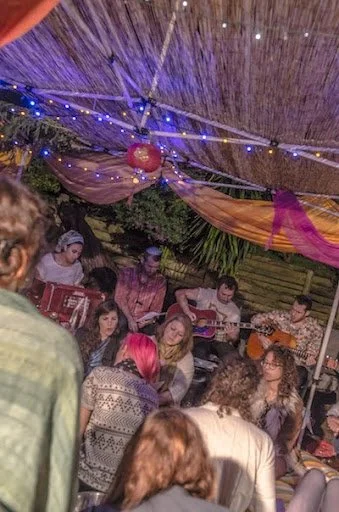
Here’s one in Sydney for Sukkot.
-
Some years ago, I attended a large Jewish gathering. It was an entire week filled with opportunities for learning, prayer, and meeting new people.
After a full and beautiful week, Friday evening arrived and I found myself at a Shabbat dinner, seated beside a man I had somehow not met during the week. He was a Rabbi, maybe 15 years older than me, and he took some interest in my work and what had brought me to the convening.
I told him that I was a Kohenet - he had never heard that title before so I explained that
I’m a Jewish spiritual leader whose work is grounded in earth-based, embodied, counter-oppressive practice.
This was not a new experience for me and I knew the drill since most people follow up with a question of “but what do you do?” Or “but why didn’t you just become a rabbi?”
I’m prepared to respond to those questions but I was not prepared for what came next.
He looked me in the eye and asked, in a surprisingly kind way, “You know that’s not real, right?”
I took a breath and smiled at him. “I’m not sure how that could be because I feel so real.”
The conversation took some twists and turns from there and ultimately, we parted on pleasant terms.
I’ve thought about that night a lot, in part because I want to be real - for the families who I accompany to a graveside, and for the kids I support in crossing the threshold when they’re called to the Torah. For the people who are seeking a community where they can belong, and for the people who want to learn in ways that include their whole selves. For all of these people, I’m committed to being real and to holding spaces in ways that allow them to be real, too.
Welcome to Rest to Return, a podcast for a restless world. I’m Kohenet Keshira haLev Fife and I’m your host. This series is rooted in Shabbat, an ancient Jewish practice that teaches us how to belong to time. Here, rest is a sacred rhythm woven into who we are.
We continue by gathering around a single question: What makes time sacred?
This is an invitation to return. Sacred time starts now.
When we peel back layers of how society and culture are structured, we might be surprised to learn that most of it is constructed. Things really only become “real” by communal agreement.
That might seem esoteric or slippery but, at its essence, it’s simple: things become real, when they feel real to enough of us, that we act like it. Time and gender are society-wide examples of this but we experience it at various scales.
From fashion trends to women wearing tallit, there is a tipping point at which enough people buy into something. Legitimacy arises from collective consent, not from declaration alone.
This happened to me, almost by accident. More than a decade ago, I decided - without any credentials or even an invitation - to host a Kabbalat Shabbat gathering. We came together outside on a beautiful summer’s night and, as I got up in front of the group, I suddenly felt like we were “playing shul”, the way my friends and I used to play school when we were kids. In those days, we all agreed that someone was the teacher and then we all played our roles. In this case, everyone had agreed that I was the leader and they were all willing to play along, singing to their hearts content. They even got their kids in on it!
Before long, Kabbalat Shabbat went from being an occasional event to a monthly gathering and, along the way, High Holiday services and a Jewish education program developed, too. As each thing emerged, I would assess by asking myself: do enough people believe in this for it to become real? And then I’d wait, watching registration numbers climb and fielding calls from the parents of prospective students.
It seemed that somewhere between my dream of an inclusive, musical, magical community and their yearning for a place where they could belong sat the possibility of something becoming real. All it took was for us to agree that we’d keep going and growing. And so we have.
Some might assume that this endeavour was intended to be entrepreneurial or simply “filling a need” and it might be that those things are true. However, Kesher Pittsburgh didn’t start as a business idea or a desire to be all things to all people. We had a very specific idea in mind of who our community was and - importantly - we believed that we had agency to create it. Along the way, we’ve become even more clear about who we are and what our sacred purpose is, and we’ve become more bold about expressing it.
Put another way: we trusted that we had the capacity to create and we knew that we could name things toward creation.
Why would I think that, especially in the face of people with more authority questioning my realness? Because I was created b’tzelem Elohim - in the image of the Divine - and it’s among the most compelling pieces of Jewish wisdom that I’ve encountered.
In the very first chapter of the Torah (Genesis 1:27), we find the written proof of our own Divinity:
וַיִּבְרָ֨א אֱלֹהִ֤ים ׀ אֶת־הָֽאָדָם֙ בְּצַלְמ֔וֹ בְּצֶ֥לֶם אֱלֹהִ֖ים
And God created humankind in the Divine image, creating it in the image of God.
By the transitive property, we can then conclude that if God is a Creator, and we humans are created in God’s image, then we too have the ability to create.
In order to create, however, we must first be able to dream. I once heard someone say that it's impossible to dream without resting deeply enough to get to REM sleep. Which means that capitalism, by keeping us chronically underrested, is robbing us of our ability to dream.
Jewish tradition teaches that dreaming is one-sixtieth of prophecy. Without dreaming, we lose access to imagining our future; we have no way to weave Olam Habah.
When we rest deeply enough to dream, when we make space for prophecy, we emulate and embody Divine source through how we love and lead, build and weave - through relationships and yes, through our work - all of this mirrors creation. Through our words and actions and dreams, we create worlds every day.
This idea has informed one of my strongest values: the idea that every person on the planet - no matter the colour of their skin, the size of their body, their gender, their class, whatever identities they carry - they are created as the very embodiment of the Divine and they should be treated as such.
But that’s not all. This text taught me that this also includes me. That I carry a Divine spark inside of me, and that I have the ability to create worlds.
And it might seem obvious but it bears saying explicitly: it includes you, too. You carry a Divine spark inside of you, and you have the ability to create worlds.
This is helpful as we construct the world we deserve and desire because it invites us to combine our creative agency. And it’s also tremendously potent when we consider how it intersects with our understanding of time.
As I said in episode 5, fundamentally, time is rooted in natural cycles. From the smallest measure of natural time - the rega, or the blink of an eye, we can stretch the slinky of spiralinear time to the cycle of the Jubilee, which is the 50th year after 7 shmitta cycles of 7 years each.
Jewish time moves according to a soli-lunar cycle, not inherently but because we’ve ascribed meaning to those cycles, both through our sacred text and through the ways that we celebrate holidays and seasons.
It also moves with the weekly cycles of time, through our communal agreement about the importance of Shabbat, even if we have varying practices that mark it as holy.
For some of us, we take a traditional route of lighting candles, switching things off, gathering for a Shabbat meal, and allowing sacred time to unfurl before us. For others, we might mark this time through modern ritual - it might be listening to a Shabbat playlist while driving to dinner on Friday night. It could be as simple as making (or buying) a special dish that we enjoy each Shabbat afternoon, using special body products to bring a little luxury into the day, or engaging our senses in various ways. For some, it might be going tech-free, or not driving.
For me, Shabbat is marked by holding a loving boundary whereby I don’t accept any obligations beyond leading Shabbat services every now and again. I do this to create contrast from how I move through the rest of the week, overscheduled and experiencing time in one hour increments. On Shabbat, there are no errands, no logistics, and no social expectations; a different quality of time simply unfolds before me.
All of these activities not only help to mark Shabbat as separate, they also give us a way to bend time. To stretch the slinky of time. To signal to our nervous systems that something different is happening now, and that it’s safe to rest. On Shabbat, when I inhale, I feel the ruach Elohim, the Divine breath, entering into my body a little bit more deeply. It reminds me that I am in relationship with Holy breath all the time, and that on this day, I get to rest in this awareness.
Whenever we consciously choose to embody Shabbat, we make it sacred.
A question arises: does Shabbat really happen if we don’t pay attention to it? For me, the question isn’t really whether it happens or not, but what happens to Shabbat if we don’t pay attention to it?
One definition of God is the constant and eternal unfolding of time and space. Needless to say, this doesn’t require our agreement or even our involvement to unfold. However, if Shabbat comes and goes without us sanctifying it, without remembering it, without beautifying it, without keeping it, we begin to lose something, if not individually, then collectively. And, if enough of us let it pass without honouring it in some way, it will eventually lose its potency. It will become just another day to enough of us that the Shabbatness of it will cease to matter. Perish the thought.
In the 14th century, Geoffrey Chaucer proclaimed, “As tyme hem hurt, a tyme doth hem cure” or, in modern parlance, “time heals all wounds”.
It’s a beautiful sentiment but, as it turns out, it’s not quite true. For, left to its own devices, time won’t do anything except roll forward, coinciding with moon cycle and season. It won’t inherently do anything more. That’s our job.
If I were to go head to head with Chaucer, I would counter him by saying, “time doesn’t heal all wounds. But what we do with time might!”
That is to say that we have a role in making time matter. And, extrapolating from there, it’s really the way that we interact with time that makes it sacred. Every holiday, including and especially Shabbat, becomes sacred time because we deem them to be, and then act accordingly.
If that lands uncomfortably, consider what would constitute Shabbat if there wasn’t a soul on the planet lighting candles or making kiddush. Those two ritual acts are what officially start Shabbat and what make it holy. The very act of sanctification is a communal construct, no more or less than what makes food kosher, or counting seven days of shiva.
Put another way, a communally constructed relationship to time, and its sanctification over generations, are what we come to call “tradition”. Part of what makes tradition so powerful is that people have repeated it over a significant period of time, and each adjustment from their original inception tells a story about the historical context of the time in which the practice shifted.
Making change and creating new constructs means bringing our agency to bear on tradition; this doesn’t diminish it. These redefinitions, these shared agreements to widen some of our understandings of “how things are done”, they expand the possibility of belonging.
When we understand and value the capacity for making, altering and reconceiving of ritual and tradition, we shift the entire framework from asking “what makes time sacred?”
The answer, of course, is we do.
Time becomes sacred only through our conscious action. Through our rituals and embodied experiences that mark a threshold that invites us in. Through our willingness not only to declare time as sacred but to practice as though it’s true. Through our shared agreement that things are holy, we make them real.
For our practice today, we’re going to journey into our memory bank to remember the feeling of constructing sacredness.
We begin by identifying a moment in your life when you were carried by the power of shared experience - a wedding, or a concert, or a shared ritual moment, that brought you into time-beyond-time. A moment that paused, or perhaps stretched out, for long enough that you became aware of the Divine spark within you?
It might have been the feeling of singing with thousands of other people, or the elevated moment when you became aware that all is connected, that all is made of love. Or it might have been the feeling of being held in a web of Being.
When you touch into that moment, what do you feel in your body? What sensations arise?
Can you remember the energy that swirled, the feeling of being present in a moment that was stretching out enough to hold everyone?
Revel in that energy for these next three minutes, resting in the awareness of shared sacredness.
As we emerge from this practice, take a moment to notice how your body feels. You might take a kinesthetic snapshot so that you can remember how it feels to make sacredness with others.
When the sun sets on Friday night and you prepare to welcome Shabbat, you might return to this feeling, to this moment, to the power of making sacred time together.
Rest well, dear listener. And join us next week as we reflect on this journey, invite integration, and deepen into the practice of real-time rest.
Gratitude to Lippman Kanfer Foundation for Living Torah for making Rest to Return possible. Rest to Return is a production of the Institute for the Next Jewish Future and part of the family of podcasts of Judaism Unbound. Hosted by Keshira haLev Fife, directed by Joey Taylor, produced at Monastery Studios, sound engineering by Justin Watson, original music by Keshira haLev Fife, arrangements by Ric Hordinski and art by Katie Kaestner.