
EPISODE 4: Couplet Rhymes
Show Notes
Here is the Rauh Jewish Archives entry about Congregation Torath Chaim.
You can learrn more about the Torath Chaim Cemetery here (23:12-25:10).
The concept of b’tzelem Elohim comes from Genesis 1:27.
You can learn more about Kohenet Jo Kent Katz and her work here.
You can learn more about Kohenet Jo’s work with Transcending Jewish Trauma here.
Abraham Joshua Heschel calls Shabbat “a sanctuary in time” in his book, The Sabbath: Its Meaning for Modern Man.
You can learn more about Octavia Raheem and her work here. The quote that I refer to in this episode comes from her podcast, Leaders Devoted to Rest.
Enjoy the live version of Lay it Down, Let it Go here.
This episode is brought to you by the Institute for Jewish Spirituality. Rest to Return exists because we believe slowing down is a spiritual act. IJS believes that too. For over two decades, IJS has been helping people go deeper through Jewish mindfulness, meditation, contemplative prayer, sacred text study, and embodied practice. Their offerings range from online courses and silent retreats to immersive cohort programs for seekers of all experience levels, clergy, and spiritual leaders who are ready to live and lead from a more grounded place. Kohenet Keshira haLev Fife is part of IJS’s core faculty, and the wisdom you'll hear in this series is very much in that spirit. If this podcast is stirring something in you, IJS is a place to go further. Explore their programs, and more ways to learn and practice with Keshira, at jewishspirituality.org, including:
View the latest offerings from IJS in our program catalog
Join Keshira and others on retreat this August: Returning Anew
Learn more about Shevet, IJS's community for younger adults (20s-30s)
IJS has several online free practices with Keshira and our other faculty including our live Daily Sit, our weekly Shevet Sit for younger adults (under 40), and monthly Affinity Sits for Jews of Color, LGBTQ+, and individuals with disabilities. Click here for more information.
Join our mailing list to be notified about our upcoming fall courses, including Keshira's Earth, Moon, Mindfulness year-long class.

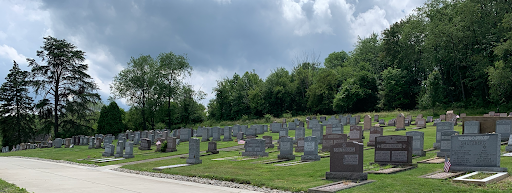
Here’s a photo of Torath Chaim.
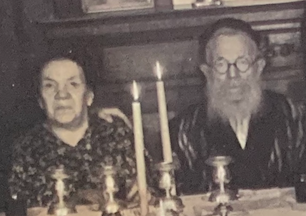
Here is a photo Bubbe and Zayde from 1935.
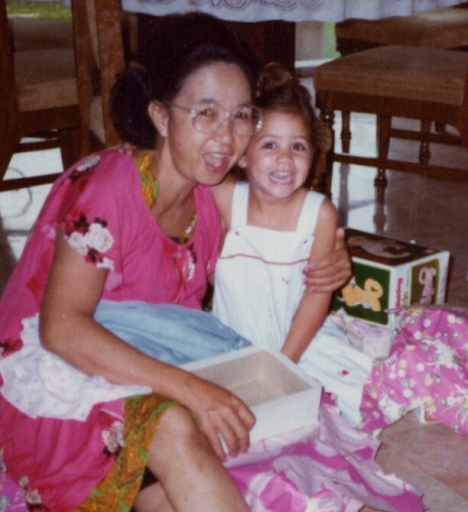
Here’s a photo of my with my Grandma Bel.
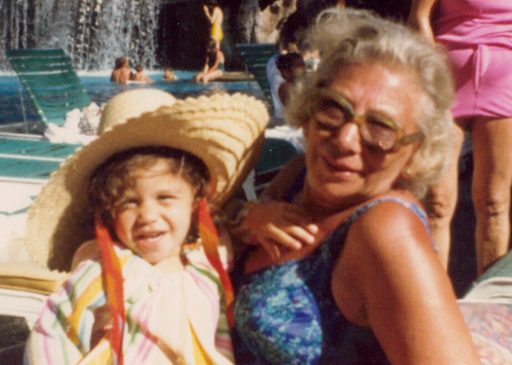
Here’s a photo of me with Grandma Rosie, who lovingly referred to me as “pussily faigel”, Yiddish for “little bird.”
-
Next year will mark 100 years since my great, great grandparents co-founded a synagogue in Pittsburgh, called Congregation Torath Chaim.
Though I never worshipped there, I have a long deep history with the cemetery that was formed by that community. I grew up going there, tending to the graves, and wandering through our family section and, I recently came to realise that I’ve known the exact spot where I’ll be buried since I was five years old.
When I go to that place, I’m always filled with the awareness that these are my people. I never met my great, great grandfather, who everyone just called Zayde, but he taught me the importance of taking on a leadership role and forming a community of belonging. And how his wife, Hannah - Bubbe - she taught me how to care for family. I think of her every time I place candles in the candlesticks that she carried from Belarus when they crossed the sea.
In that graveyard, there are also socialists whose memories give me strength when people tell me that I’m naive because I believe that everyone should have enough.
My grandma is also there - she’s the one who first planted words of Yiddish in my ears when she called me, “pussily feigel” or “little bird”.
Of course, this is not the whole story of who I am. My maternal lineage is thick with people who taught me how to love through food, how to embody joy, and how to be faithful.
And of course there are others whose stories come only in remnants, and there are ancestors who I know nothing about, other than that they originated somewhere else and that they made the journey to these shores.
On both sides, I come from lineages of people who discerned when it was time to move and when it was time to settle. And they followed rhythms - both beset and internal. They worked hard when it was time and they also knew how to rest deeply.
From time to time, I visit my place at the cemetery, which is now right beside my dad’s, and I consider what it means that I’ll rest in that place, when the time comes…what it means to join the ranks of generations who came before, the very people whose DNA and values I’m made of.
Welcome to Rest to Return, a podcast for a restless world. I’m Kohenet Keshira haLev Fife and I’m your host. This series is rooted in Shabbat, an ancient Jewish practice that teaches us how to belong to time. Here, rest is a sacred rhythm woven into who we are.
We continue by gathering around a single question: Where do we find permission to rest?
This is an invitation to return. Sacred time starts now.
As Jews, we’ve inherited a technology and rhythm of rest, one that insists upon this cycle as a way to structure our lives and to sustain our sacred work. If we only understand an inheritance as wisdom that’s handed down, we miss out on the way that an inheritance can be a living relationship across generations.
We start with a question: who taught you how to rest? Was it your parents, your grandparents, your teachers, your ancestors, whether by DNA or by spiritual lineage? Who, by example or by story, showed you what it means to set everything down, and to let yourself simply be?
The fact that this question needs to be asked points to something important: many of us are living in a world, and often inside of bodies, which carries the message that rest is conditional. That it’s something to be earned, justified, or at least postponed until everything else is done. But, of course, our sacred work is never complete. And we forget that it requires rest in order to be sustained. We forget that we’re made of Divine matter and that we’re worthy of being treated as such.
Instead, many of us experience a kind of rest that’s accompanied by a subtle sense of guilt, or anxiety, or at least a sense that we’re doing something wrong, indulgent or irresponsible. That we could be spending time in a “better” way.
When I considered this in my own lineage, I began to ask myself questions like: who modeled rest for me? And who showed me how to work hard? What did those people believe about the balance between work and rest, and who or what informed their understanding? What I learned - explicitly and implicitly - was that rest was considered a necessary activity in service of continued work. I came to wonder: who was the last person in my lineage who rested for rest’s sake?
From that perspective, I become aware that I get to make a choice and the one that I make is this: in service of healing my ancestral lineage, and of kinking the chain of Jewish tradition with love, I offer myself - and you - this gentle permission to rest.
Somehow, a gulf has formed between the inherent permission contained in the Torah, and the permission we give ourselves. Some might say this is a result of failing to strictly observe Shabbat in a halakhic sense. I disagree because I’ve witnessed people who follow Shabbat to the letter of the law, but don’t seem to get much rest on Shabbat; it’s entirely possible to appear restful while the mind buzzes with to do lists and worries.
There was a time when I understood the phrase “I can’t rest” to mean “there’s too much to do”. It’s certainly no less true these days but I’ve started to wonder whether it’s also possible that we’re so out of practice that we’ve lost the actual ability to bring ourselves to rest. If we need both the ability to rest and the permission to do it, how do we get to the point where we have both?
As a child, we would go to visit my grandma each Saturday afternoon; there were lots of things which made our visits special but one thing I remember in particular is that, while my dad always had things to do during the week, on Saturday afternoons, he would say that he was going to “chap a drimmel” - grab a dream - and then go and take a nap on my grandma’s sofa. Even in a family who didn’t have a conscious Shabbat practice, there was something inherent in that time that called my dad toward deeper rest and an echo of permission that allowed him to go with it.
To this day, I wish that my dad had realised that rest wasn’t a reward but his birthright. That ceasing wasn’t a failure to create but the very completion of a cycle of creation. That each time he let himself rest he was becoming a couplet rhyme in the ancestral rhythm that structures our lives. That he was opening to the possibility of returning to the best version of himself, b’tzelem Elohim. By giving ourselves to rest, we create a rhyme to go with the ancestral rhythm that structures our lives, and we teach the next generation that song.
The narrative that my dad lived into, even while letting himself nap on Shabbat afternoons, was that work is always more noble than rest; perhaps this was a message that he had received from someone who came before.
Kohenet Jo Kent Katz teaches about intergenerational trauma patterns among Jewish people, explaining that, “Behaviours which were once vital to our ancestors’ very survival can become maladaptive, remaining long after the traumatic context is behind us. This happens when trauma goes unaddressed, or when people aren’t aware that they no longer need to remain in postures of vigilance; Effectively, they become trauma responses.”
I can remember times in my life when I fed exhaustion by perpetuating the internalised narrative that being tired is a mark of worthiness, that it shows that I’m earning the right to rest…only to come crashing down on myself when I’d finally stop. Exhaustion quickly turned to illness and I’d lie in bed recovering while wondering who in my lineage had worked themselves like this.
Often when we ask the question “can I give myself permission to rest?”, we might really be asking questions like “is it safe to stop?” or “who am I if I’m not useful?” or “if I slow down, will I be left behind?”
Regardless of how those patterns manifest, if left unchecked, they are passed from generation to generation, sometimes without the awareness that they’ve become trauma-in-action.
The same is true about rest. Whatever messages our ancestors gave us about rest are likely to be woven into our own understanding and relationship to it. Our ancestors' relationship to rest, which was shaped by their drive for survival - by needing to flee, by needing to work to prove their worth in hostile lands, by the sense that it wasn’t safe to let their guard down - all of that lived in their bones, and it’s in ours too. Today, it manifests as stories like “hurry up, there’s no time to waste” or “there’s always more to do; there’s no time to rest”, which push us to keep moving - in order to prove our worthiness or simply to belong.
We are in a time now where intergenerational patterns are being amplified by external voices, forces that can easily strip us of our capacity to rest, or at least make it hard to give ourselves permission.
We return to the core question: where do we get permission to rest?
Optimally, we give it to ourselves. And because this can be so hard, we also give it to each other, and receive it in turn. This act of compassion and care lets us weave our web with gentle strength.
From this perspective, it seems that the question is not only about permission but also about responsibility for upholding what we give permission for. By giving ourselves permission to rest, by giving one another permission to rest, by taking responsibility to protect that practice and that space for one another, we ensure that the boundaries don’t recede.
Where permission alone upholds hierarchy, permission paired with responsibility subverts dominance and allows us to release patterns that no longer serve us, preserving the preciousness of our inheritance while embracing what we need in today’s world.
This, too, is the sacred work of weaving the cosmic web; this, too, is how we make our ancestors’ memories a blessing.
The Torah teaches that on the seventh day, The Divine rested. There is no mention of the idea that They had earned rest by creating the cosmos nor was there any indication that They were resting in order to have the capacity to work more the following week. It simply teaches that the Divine rested, and that we should too.
In some circles, this is all the permission that’s needed to disengage from the capitalist machine and to block out the world while entering into what Abraham Joshua Heschel called, “a palace in time”.
For the rest of us, permission might come in the form of a gentle reminder: Rest is our birthright, passed down through generations, not because we’re Jewish but because we’re both human and divine.
Shabbat is the embodiment of this. In the words of Octavia Raheem, “when I rest, I remember who I am, and whose I am.”
I belong to myself, to my people - my family and my community, I belong to a long lineage of ancestors who preceded me and I belong to those yet to come. And, ultimately, I belong to the Holy One, to the earth, to the cosmos.
When I remember this, I am moved by the infinitude of potential futures. We are blessed by so much of what previous generations have gifted us, and we are responsible not only to carry those gifts forward but to discern what to bring and what to lovingly set down. What to preserve and what to evolve. By doing this, we enter into deep relationship with the question: if intergenerational trauma can constrain us, is it possible that intergenerational resilience might heal and liberate us?
I believe that it will - for when we slow down, when we engage in our sacred work, when we weave futures that are loving and just and radically inclusive and humble, when we let ourselves rest deeply, we are seeding a future that’s liberated, integrated, and whole. And from that place, we are living into who we might become, and into what we might create together.
Today, I invite you into a reflective practice of ancestral connection and co-resting.
Bring to mind an ancestor; someone who has informed your relationship with rest and notice how it manifests in your life today.
Imagine now: what would it have been like to rest with them, in their home, in their time?
Once you’ve allowed your heart to settle there for a few moments, imagine bringing them forward, to your home, in your time. How might you rest together today?
Over the next three minutes, take this time to rest together, imagining how it would feel to be side-by-side, resting across generations.
It might be that it’s easy to imagine resting with that ancestor because they embraced the practice with ease.
If it feels less accessible, you might consider how you could give one another permission to rest, and how healing it could be.
As we emerge from this brief time of shared rest, take a moment to notice how you feel.
Something as simple as allowing yourself to be in imaginal space can create intergenerational connection, bring healing, and gently help us to re-pattern our relationship to rest.
You might take a moment to feel gratitude for this ancestor, for this experience, and for this inherited jewel. It might be something to tuck into your pocket, or into your heart, so that you can pass it on to future generations as healed and whole.
Rest well, dear listener. And join us next time as we explore the slinky of time, how it expands and contracts, and how its sacredness is our sacredness, too.
Gratitude to Lippman Kanfer Foundation for Living Torah for making Rest to Return possible. Rest to Return is a production of the Institute for the Next Jewish Future and part of the family of podcasts of Judaism Unbound. Hosted by Keshira haLev Fife, directed by Joey Taylor, produced at Monastery Studios, sound engineering by Justin Watson, original music by Keshira haLev Fife, arrangements by Ric Hordinski and art by Katie Kaestner.