
EPISODE 3: Rhythm of Rest
Show Notes
I learned about spiralinear time from Kohenet Sara Esther Richards who wrote her Masters Thesis, Spiralinear Time: Religious Calendar Formation, Momentum, and Change within a Dynamic Time Structure, on the topic.
We learn about the shmitta in Exodus 23:10-11
The Jonathan Sacks quote, “Shabbat is the day we stand still and let all our blessings catch up with us.” comes from his book, Radical Then, Radical Now.
The words to Lecha Dodi by Shlomo Alkabetz can be found here. “Shamor” (keep/guard) and “zachor” (remember) are in verse 2.
The 39 melachot can be found in the Mishnah (Shabbat 7:2).
If you want to find out whose land you’re on, https://native-land.ca/is an excellent resource.
You can find out how the moon is cycling in your particular location here.
Here is a rendering of the Kabbalistic Tree of Life overlaid on a human body.
Enjoy the live version of Lay it Down, Let it Go here.
This episode is brought to you by the Institute for Jewish Spirituality. Rest to Return exists because we believe slowing down is a spiritual act.IJS believes that too. For over two decades, IJS has been helping people go deeper, through Jewish mindfulness meditation, contemplative prayer, sacred text study, and embodied practice. Their offerings range from online courses and silent retreats to immersive cohort programs for seekers of all experience levels, clergy, and spiritual leaders who are ready to live and lead from a more grounded place. Kohenet Keshira haLev Fife is part of IJS’s core faculty, and the wisdom you'll hear in this series is very much in that spirit. If this podcast is stirring something in you, IJS is a place to go further. Explore their programs, and more ways to learn and practice with Keshira, at jewishspirituality.org, including:
View the latest offerings from IJS in our program catalog
Join Keshira and others on retreat this August: Returning Anew
Learn more about Shevet, IJS's community for younger adults (20s-30s)
IJS has several online free practices with Keshira and our other faculty including our live Daily Sit, our weekly Shevet Sit for younger adults (under 40), and monthly Affinity Sits for Jews of Color, LGBTQ+, and individuals with disabilities. Click here for more information.
Join our mailing list to be notified about our upcoming fall courses, including Keshira's Earth, Moon, Mindfulness year-long class.

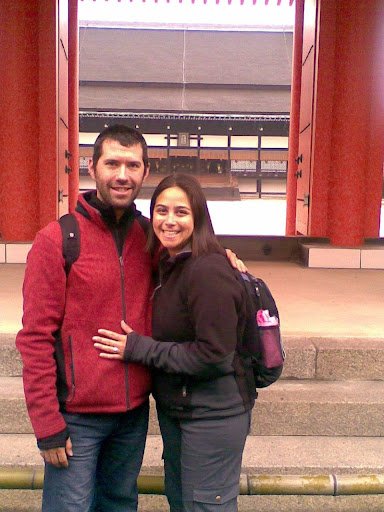
Here is a photo of us at the beginning of our first shmitta year; this was taken in Kyoto, Japan in January 2009.

Here is a wallaby who came for a visit.

Here are some Mexican sands and brambles.
-
Some years ago, on a rainy Friday afternoon, my beloved and I set out for a drive up the east coast of Australia, with the intention to camp somewhere in the northern rivers, en route to Queensland.
The further we drove, the harder the rains became, until it was evident that we couldn’t possibly pitch a tent unless we found somewhere under cover.
Instinctively, I wondered whether the Divine web of interconnection might catch us. I updated my Facebook status to inquire whether anyone in the area might have a covered space where we could take respite for the night and, within an hour, someone - a person who I had met only once - replied to say that she was away but that we were welcome to stay at her house. “Next to the sliding glass door, there’s a ceramic frog with a key beneath it. Go right inside and make yourselves at home.”
We arrived at dusk and, by the time we got inside, I was drenched, exhausted, and feeling just a touch homesick.
We decided to take a rest, lying on a daybed that was sheltered by the deep Queenslander roof that’s so common in those parts.
With the rain coming down, we began to sing a few Shabbat songs, to help ourselves ground and to mark sacred time. That night, Shalom Aleichem and Lecha Dodi wafted through the air and, for the first time, I experienced new words coming through to match an ancient tune.
To this day, I never sing that song without remembering the kindness of relative strangers, the strength of the web, and the way our senses can transport us home.
We woke up the next morning to birds chirping and bright sunshine; after an evening of deep rest, it was time to go. We left with appreciation for the intangible cosmic web that holds us. And as we rolled on, we wondered when we might next have the opportunity to serve as the safety net for someone else?
Welcome to Rest to Return, a podcast for a restless world. I’m Kohenet Keshira haLev Fife and I’m your host. This series is rooted in Shabbat, an ancient Jewish practice that teaches us how to belong to time. Here, rest is a sacred rhythm woven into who we are.
We continue by gathering around a single question: How do we know when to work and when to rest?
This is an invitation to return. Sacred time starts now.
Jewish time moves in spirals, expanding and contracting, gathering us up in its rhythm and guiding us toward movement and slowness. Like a slinky, it stretches and shrinks, creating contrast between movement and stillness in a way that awakens deeper awareness, helps us to build trust, and calls upon us to rest and release. In the case of Shabbat, we are invited to experience this every single week: at sundown each Friday, we are taught to set down our work and our attempts to dominate time.
If we zoom out beyond a week, a month, or even a year, we find the shmitta cycle, which, after six years of work, commands us - as a society - to let the land lie fallow, to forgive debts and return property, and to release those who have been working under oppressive conditions. The power of the shmitta lies in the communal aspect; done individually, these activities qualify as ethical and moral actions. Done collectively, they transform the land, the culture, and everyone who participates.
Effectively, Shabbat and shmitta are the same sacred rhythm but on a different magnitude. As we pull the slinky out to elongate time, the scale of involvement and impact also grows.
In an age far removed from agricultural life, reclaiming and reinterpreting the shmitta invites us to consider what it would mean to let parts of our own lives lie fallow and, in doing so, to rediscover a rhythm of movement and stillness, that rests us deeply enough to offer ourselves fully to our sacred work.
By 2009, my beloved and I had been living and working in Australia for 4 years. Taken in by a culture which normalised setting work aside in favour of long stretches of travel, we decided to take a gap year. At that time, neither of us had ever heard of the shmitta.
As hard as it is to imagine, we had given up our jobs and were about to set out into the world with no agenda other than to learn about how people in other places lived.
We set out with lists upon lists of places to go and things to experience. Day after day, we walked through cities and towns, observing people, tasting new treats, and learning about history, culture and religion. We spent that first week in Japan: Shinjuku and Shibuya and Harajuku. The early morning fish market and the late night izykayas. The tori gates at Fushimi Inari. Palaces and museums and city parks. It was an incredible week and I remember feeling satiated and grateful as we boarded our flight to Beijing, where there was so much more to see and do.
No work meant no need to rest, right? We’d just sleep at night - even if on a train or a bus - and be fine!
We had big plans for China, Hong Kong, Southeast Asia, and beyond and, well, it took exactly six days before I hit a wall. It didn’t matter what was on offer at this market or that festival, or if museum entry was free, I simply couldn’t go on for one more day. I announced that I would be sleeping in the next morning and that I was not likely to get out of bed for a few hours even after I woke up.
As it turned out, even if not working in the traditional sense, our natural rhythms dictated that for six days we’d have lots of energy for exploration, walking miles in all weather, navigating new places, and generally bathing in wonder…and that, right around the seventh day, we needed a rest.
No matter where we went throughout that year - Thailand or Turkey, Morocco or Mexico - every single week required rest.
During that first shmitta, Shabbat was often spent cataloguing our photos, updating our blog, doing laundry, and making use of hostel internet to make future logistical plans, all activities which are prohibited by halakha, or Jewish law, but which felt restful and relieving in comparison to how we spent the rest of the week.
Because we weren’t working in a traditional sense, Shabbat was not about appreciating what we had achieved, it really was about rest for the sake of rest. And perhaps because we weren’t working, we had to learn how to let rest in, even when we hadn’t done anything to earn it. In short, we had to accept that we were deserving of rest and in the words of Rabbi Lord Jonathan Sacks, z”l, to stop and “let our blessings catch up with us.”
Each week when we came to rest, I had the distinct sense that the slinky of time was expanding and contracting, providing a weekly rhythm of movement and stillness, work and rest, as a fractal within an entire year of rest and release.
By the end of the year, we were enamored with both this newfound rhythm of time, and with all that we encountered as we went on this global wander. Before we had even settled back in Sydney, we decided that we wanted do the shmitta again…in seven years. And, what's more, we decided to hold on to our weekly Shabbat rhythm.
Our shmitta practice has continued in a seven year cycle and though the parameters have been different each time, the fundamental questions have always guided us: what is our relationship to time and to rest? And how can we be more aligned with natural cycles in a way that helps us to return to our values and to trust more deeply?
Each experience has been underpinned by a desire to bring deep rest in contrast to whatever we've been doing in the previous six years. Doing this is a way of checking in with ourselves, noticing which activities we miss and where this is relief in letting go. It’s also an invitation to make some adjustments, revisiting long-held assumptions and questioning whether we still believe things that were once so formative to how we understood the world. In doing this, we inevitably expand our worldview, we gently unlearn old ways and make space to learn new ones. We become more agile and flexible and we practice non-attachment - to plans, to titles, to stuff. And, above all, this time helps us return to ourselves in a deep way, inviting us to reconnect with our sacred purpose and to recommit to our place in the context of our collective sacred work.
Each journey is also guided by a larger question; a question which generally emerges within a short time after we begin.
During our 2016 shmitta, our central question was: how do we know when to move and when to rest?
Though this question might seem to be relevant only to those who are living a nomadic lifestyle, they can extend in a lot of directions. If we think of travel or movement as a form of work, and stillness as a form of rest, it might become easier to consider the question this way: how do I know when it’s time to work and when it’s time to rest?
Whether moving or not, the cycles of work and rest still apply. The questions of…”how do I attune to what’s needed? how do I know when it’s time to rest?” These are questions that each of us must explore on our own, tuning into our inner wisdom, often expressed through the body, and opening ourselves to its messages, even when they might be difficult to receive or to translate.
If we can get there, attuning to our own inner sense of when it’s time to “move” and time to “stay still” becomes an act of empowerment, one that builds confidence in our discernment and helps us settle into a rhythm that feels natural to each of us.
Weaving Shabbat with our own internal awareness yields an approach that’s complex…and also perhaps more suitable with life as so many of us live it today. Where we might otherwise determine that Shabbat is incompatible with our lives and simply forgo it, we can instead mediate it through our own intrinsic rhythms, marking it as sacred, while also choosing other times of the week to rest as well.
This is because, in today’s world, Shabbat does not provide enough time or space to rest as deeply as we need to, especially if we find that the traditional activities of Shabbat aren’t conducive to rest. Instead, we can distinguish Shabbat - a sacred time of rest - from the practice of rest that we might need in other times of the week.
In other words, just as we don’t have to cram all of our rest into 25 hours, we also don’t have to forgo Shabbat in favour of our own rhythms, we can layer them. If your schedule means that Saturday is spent at soccer practice and that Monday is when you can rest, you might choose to create some ritual to enter into that time of rest. And, you might also light candles on a Friday night, to uplift the sacredness of Shabbat and to honour the rhythm that we’ve inherited.
Every Friday night, Jewish people around the world sing Lecha Dodi, which draws from two verses of Torah, reminding us to “guard” and “remember” Shabbat. Within the pairing of “shamor/guard” and “zachor/remember”, the traditional practice is to lean into the idea of guarding Shabbat though prohibiting activities derived from the 39 melachot.
People sometimes nod to the Ashkenazi Yiddish, asking me if I’m “shomer Shabbos”. Often, I’ll reply, “no, I’m Zocher Shabbos”, as a way to reflect back that I’m choosing “remembering” instead of “guarding”. Equally holy, to do this means not observing Shabbat in a traditional way but rather enlivening, honouring, and experiencing it in ways that not only feel resonant but which serve as a healing balm. When I’m able to let go of the need to guard, I’m able to let down my own guard, loosening and softening into rest.
As I reflect on my experiences of traveling for extended time periods, I’ve noticed that, in some ways, I feel more at home, more at ease when I’m on the move. Rather than feeling unmoored, I’ve come to feel self-contained, grounded in my body and in myself, mostly because of the various rituals and routines that keep me steady while in motion.
Sometimes I wonder whether this is because the Jewish nomadic tradition is embedded in my bones, lingering in my DNA. I come from a tradition of people who moved, not in every generation, but at various points in my lineages. I know that, in different times and places, people made the choice to move for different reasons. And I know that some of them were displaced against their will. Regardless of circumstance, each of them traveled with different embodied practices which helped to anchor them in place; when I do the same, I honour an inheritance of resilience.
For me, it’s important that I stay grounded, even amidst the changing scenery. I do this in two ways: through awareness of space and time and connection to the elements.
Awareness takes the form of inquiry into each new place, starting with the questions of “where am I?” and “whose land am I on?” When I arrive to a new place, I look at the map to get a sense of where I’m located in relation to other places I’ve visited and I take a moment to speak the names of the traditional tenders of the land. I also consider the season, what phase the moon is in, and what time it gets dark. These questions of space and time help me to orient and to know where I am and where I fit.
I also connect with the elements each time I land in a new place, noticing how they’re showing up. For example, the earth element shows up differently by place; I know I’m in Australia when surrounded by native flora and fauna and Mexico is marked by the moving sands and the patterns that are created when air and earth combine.
The bookend to this is a practice of giving gratitude for them each time we depart, listing the elements and naming one way that each of them held us during our time in that place. We might thank the water for providing cool respite, or appreciate the colourful flowers for helping us to feel the energy of blossoming and growth.
In this way, we notice what’s alive and growing in each place, how the seasons manifest differently in various landscapes, and how all places, all beings, experience growth and movement, dormancy and rest.
Through these rituals and through attuning to the natural rhythms of a place, I find myself both rooted and falling into a rhythm of rest. I have yet to visit a single place on the planet where the natural world doesn’t model a rhythm of rest and growth.
Regardless of where we are, the elements can help us to remain centered, ensuring that capitalist time doesn’t become the driving force determining when we work and when we rest. Rather than being guided by what we “should” be doing according to the clock or market, we allow the natural cycles of time - rooted in place - to help us find a natural rhythm. When we move according to our own rhythms of rest and work, we weave ourselves more fully into the web of life through which all is interconnected.
We are people of the earth - we are made of earth - and the natural world can serve as a model and mirror for how to sustain through a rhythm of work and rest. Rest supports our growth because it creates space for us to deepen our awareness and make conscious choices between rest and work, or stillness and movement.
If we think of ourselves as trees, we can imagine being the Kabbalistic tree of life, which provides a map for the various Divine emanations and energies flowing through us. In considering the balance of stillness and movement, or rest and work, we draw our attention to the legs, which are the seat of netzach and hod.
Netzach is the quality of striving, of moving forward, and progressing, even in the face of adversity. It is sometimes named as “endurance,” “determination” or “eternity”, and it’s the energy that helps us to sustain effort over time, in our sacred work. Left unchecked, however, netzach energy could get intermingled with our internalised narratives, causing us to strive beyond what’s reasonable.
Enter its counterbalance, hod. The energy that moves through the left leg, or the space between ground and pelvis. This is the channel for hod, which is associated with surrender, with stopping to allow the present moment to catch up with us, being with the world, just as it is. Hod is sometimes translated as “splendor” and is connected with the Hebrew words, hodaya and todah, indicating that it has its roots in "gratitude."
These two complementary forces remind us: there is a time to move and a time to rest, that our ability to endure comes not from endless pushing but from allowing ourselves to go with the Divine flow. This is the energy that’s being channeled through my departure ritual of acknowledging the natural world and the ways that the elements show up with netzach, determination, and hod, splendor.
Today’s practice invites us into awareness of our senses and our surroundings as a way to discern what’s needed now.
I invite you to choose a position and place that allows you to notice the natural world.
This could mean going outside, or situating yourself near a window or door.
As you settle in, bring present-moment awareness to your physical location.
Where am I? Whose land am I on? Where am I in relationship to the nearest coastline, mountain, or forest?
And now we locate ourselves in time:
What season is it? What moon phase are we in? What time will it get dark today, or when will it become light again?
Take a moment to connect to the natural world, considering how are the elements showing up today?
As you take these next three minutes to practice, I invite you to consider “what is it time for now?” Or “what is my body craving at this time, in this season?”
Are you energised toward work? Is it time to move? Are you yearning for slowness or stillness? Or something else? Whatever it is, I hope that you’ll trust in that awareness and follow your inner knowing.
As you emerge from this practice, take a moment to notice what you notice.
If you feel disconnected from the natural world, you might set aside some time to reconnect.
If you want to learn more about the indigenous people who tended the land that you’re on, you might commit to doing some research.
Of course, there’s always more that we can do. If, however, you noticed was a yawn or a sense of relief in these few micro-moments of rest, I hope that you’ll go with that, just as soon as you can.
Rest well, dear listener. And join us next time as we explore how our ancestors related to rest and what they modeled for us. We’ll even get to discern what to keep, what to reclaim, what to heal, and what to release.
Miriam: Gratitude to Lippman Kanfer Foundation for Living Torah for making Rest to Return possible. Rest to Return is a production of the Institute for the Next Jewish Future and part of the family of podcasts of Judaism Unbound. Hosted by Keshira haLev Fife, directed by Joey Taylor, produced at Monastery Studios, sound engineering by Justin Watson, original music by Keshira haLev Fife, arrangements by Ric Hordinski and art by Katie Kaestner.