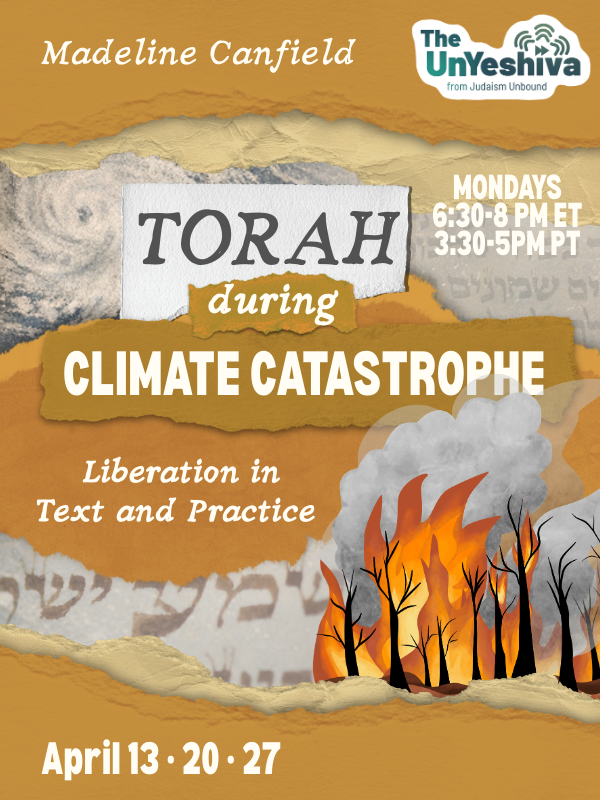
Torah during Climate Catastrophe: Liberation in Text and Practice

from $72.00

with Madeline Canfield

When

Mondays · 3 Weeks · Starts April 13th
6:30-8:00 pm ET / 3:30-5:00 pm PT

We are living in a moment of psycho-political crisis. We talk about history; we read about politics; we gather for protest – and as Jews we refract each latest development through the prism of our Jewish calendar. The onslaught of the climate crisis is enveloping us — flooding our neighborhoods, burning our institutions, smogging our air to disastrous health effects, and displacing whole collectives of lifeforms.

So the question arises…what do we do? Perhaps what we need is to access registers of response that move disaster politics beyond fixed materiality – beyond the instruments in our hands and the earth beneath our feet. Perhaps what we seek is preservation through text – a climate-emotional Torah that is both a guidepost for, and a preemptive (pre-redemptive?) embodiment of the climate justice world-to-come. Not in lieu of mass resistance, but as its conduit!

This course will hypothesize and experiment rather than teach. It will braid together psychology, critical theory, exegesis, social movement praxis, liberation theology, and more. We will analyze Jewish texts from across the historical gamut, along with literary, theoretical, political, and artistic works by Jews and non-Jews in moments of catastrophe. Over our three sessions, we will experiment with what it might look like to seek climate resilience and preservation through Jewish tradition’s immateriality: or at least, more mobile forms of material expression.

This class will be recorded and available to enrolled students to watch later.

Cost

This course is available at a sliding scale cost of $126 (the true cost), $99 or $72.

If you can afford the full price, we hope you will choose that option, which allows us to continue to offer lower rates and scholarships to those who otherwise would not be able to access this learning because of financial barriers.

If you need financial aid beyond the sliding scale, please fill out this simple form, and we will get right back to you.

Click here to donate to JUs financial aid fund to support financial equity and access to education for all students.

Sliding Scale Prices:

with Madeline Canfield

When

Mondays · 3 Weeks · Starts April 13th
6:30-8:00 pm ET / 3:30-5:00 pm PT

We are living in a moment of psycho-political crisis. We talk about history; we read about politics; we gather for protest – and as Jews we refract each latest development through the prism of our Jewish calendar. The onslaught of the climate crisis is enveloping us — flooding our neighborhoods, burning our institutions, smogging our air to disastrous health effects, and displacing whole collectives of lifeforms.

So the question arises…what do we do? Perhaps what we need is to access registers of response that move disaster politics beyond fixed materiality – beyond the instruments in our hands and the earth beneath our feet. Perhaps what we seek is preservation through text – a climate-emotional Torah that is both a guidepost for, and a preemptive (pre-redemptive?) embodiment of the climate justice world-to-come. Not in lieu of mass resistance, but as its conduit!

This course will hypothesize and experiment rather than teach. It will braid together psychology, critical theory, exegesis, social movement praxis, liberation theology, and more. We will analyze Jewish texts from across the historical gamut, along with literary, theoretical, political, and artistic works by Jews and non-Jews in moments of catastrophe. Over our three sessions, we will experiment with what it might look like to seek climate resilience and preservation through Jewish tradition’s immateriality: or at least, more mobile forms of material expression.

This class will be recorded and available to enrolled students to watch later.

Cost

This course is available at a sliding scale cost of $126 (the true cost), $99 or $72.

If you can afford the full price, we hope you will choose that option, which allows us to continue to offer lower rates and scholarships to those who otherwise would not be able to access this learning because of financial barriers.

If you need financial aid beyond the sliding scale, please fill out this simple form, and we will get right back to you.

Click here to donate to JUs financial aid fund to support financial equity and access to education for all students.


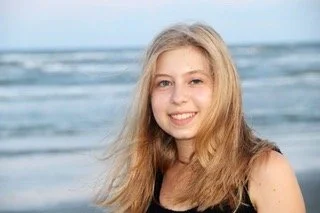
Madeline Canfield (she/her) is a first-year rabbinical student at the Jewish Theological Seminary. At JTS, she serves as a Crown Fellow, Milstein Fellow for Interreligious Dialogue, and a Slifka-Nadich Fellow supporting college and high school students. She came to train for the rabbinate through experiences as a community organizer, educator, facilitator, and writer in both climate and Jewish movement spaces. As a consultant for Adamah (where she used to work as the Youth Empowerment Education & Actions Manager), a board member of The Shalom Center (where she also participates in their inaugural post-activism Cohort א), and a member of the Jewish Earth Alliance Steering Committee, she writes develops curricula, writing, and campaigns that apply Jewish epistemological frameworks to contemporary challenges of the climate crisis. 

Madeline has developed extensive organizing experience across the youth climate and other justice movements, including as the co-founder and Co-Coordinator of Houston Youth Climate Strike, the co-developer of the City of Houston’s Climate Action Plan Youth Implementation Working Group, a committee member for the annual Houston Community Climate Summit, a member of Houston Youth Activists, a Co-Founder of Jewish Teens for Empowered Consent, and a member of the national Partnerships Team of Zero Hour. She has taught b’ mitzvah and teen learning classes at the Or Shalom Jewish Community in San Francisco, served on the U.N. Environmental Programme Faith for Earth Youth Council, and leads climate emotional resilience classes for Adamah’s Shamati Initiative. She has a bachelor’s in English Honors and Judaic Studies from Brown University.