with Ollie Schwartz
—
When
Wednesdays- 3 Weeks - 3-4:30 pm ET / 12 noon-1:30 pm PT
January 14 · 21 · 28
—
In this three session mini series we will explore the topic of Judaica production as a lens through which to explore Jewish aesthetic, ethics, and adornment practices. We will take an explicitly queer approach to our studies, pulling from queer theory, queer fashion, and zine culture as source texts. Using the pedagogy of chavrutah (traditional Jewish text study), creative practice, and our own embodiment we will travel from Tim Tum to Rambam, Muñoz to Maimonides, Tiktok to Talmud and back again. Our time together is intended for people of all Hebrew language knowledge levels, from no literacy to fluency. Misfits of all genders and sexual orientations are welcome. Our course will center around:
Kedusha (holiness)- one of Judaism’s complex, mystical, and central tenets, specifically k’li kadosh (holy objects). Kedusha touches Jewish holy objects, holy times, holy places, and how we view our covenant with The Divine. When creating objects for ritual use, we bless using the phrase “l’shem kedushat” (for the sake of holiness). What makes something kadosh (sacred)? How do we queer the halacha (laws) of Kedusha?
Hiddur Mitzvah (the commandment to beautify our practices)- the reason we make kiddush (bless wine) in a chalice not a solo cup, and why we don’t bless our challah covered by any old shmatah (rag) is Hiddur Mitzvah! As queers, why and when do we choose to beautify? And what does Jewish tradition have to teach us about the political and spiritual implications of beautification?
Ethical Ritual Production under capitalism?! - What’s Feminist Marxism got to do with it? What is at stake when we buy, sell, or produce Jewish ritual objects? What is at the intersection of Judaism and queer animism? From dipping candles in your backyard to the mass production shofarot (ritual ram horn) industry, do the Jewish laws of production have anything to teach us about ethical consumption under capitalism?
—
This class will be recorded and available to enrolled students to watch later.
Cost
This course is available at a sliding scale cost of $126 (the true cost), $99 or $72.
If you can afford the full price, we hope you will choose that option, which allows us to continue to offer lower rates and scholarships to those who otherwise would not be able to access this learning because of financial barriers.
If you need financial aid beyond the sliding scale, please fill out this simple form, and we will get right back to you.
Click here to donate to JUs financial aid fund to support financial equity and access to education for all students.
with Ollie Schwartz
—
When
Wednesdays- 3 Weeks - 3-4:30 pm ET / 12 noon-1:30 pm PT
January 14 · 21 · 28
—
In this three session mini series we will explore the topic of Judaica production as a lens through which to explore Jewish aesthetic, ethics, and adornment practices. We will take an explicitly queer approach to our studies, pulling from queer theory, queer fashion, and zine culture as source texts. Using the pedagogy of chavrutah (traditional Jewish text study), creative practice, and our own embodiment we will travel from Tim Tum to Rambam, Muñoz to Maimonides, Tiktok to Talmud and back again. Our time together is intended for people of all Hebrew language knowledge levels, from no literacy to fluency. Misfits of all genders and sexual orientations are welcome. Our course will center around:
Kedusha (holiness)- one of Judaism’s complex, mystical, and central tenets, specifically k’li kadosh (holy objects). Kedusha touches Jewish holy objects, holy times, holy places, and how we view our covenant with The Divine. When creating objects for ritual use, we bless using the phrase “l’shem kedushat” (for the sake of holiness). What makes something kadosh (sacred)? How do we queer the halacha (laws) of Kedusha?
Hiddur Mitzvah (the commandment to beautify our practices)- the reason we make kiddush (bless wine) in a chalice not a solo cup, and why we don’t bless our challah covered by any old shmatah (rag) is Hiddur Mitzvah! As queers, why and when do we choose to beautify? And what does Jewish tradition have to teach us about the political and spiritual implications of beautification?
Ethical Ritual Production under capitalism?! - What’s Feminist Marxism got to do with it? What is at stake when we buy, sell, or produce Jewish ritual objects? What is at the intersection of Judaism and queer animism? From dipping candles in your backyard to the mass production shofarot (ritual ram horn) industry, do the Jewish laws of production have anything to teach us about ethical consumption under capitalism?
—
This class will be recorded and available to enrolled students to watch later.
Cost
This course is available at a sliding scale cost of $126 (the true cost), $99 or $72.
If you can afford the full price, we hope you will choose that option, which allows us to continue to offer lower rates and scholarships to those who otherwise would not be able to access this learning because of financial barriers.
If you need financial aid beyond the sliding scale, please fill out this simple form, and we will get right back to you.
Click here to donate to JUs financial aid fund to support financial equity and access to education for all students.

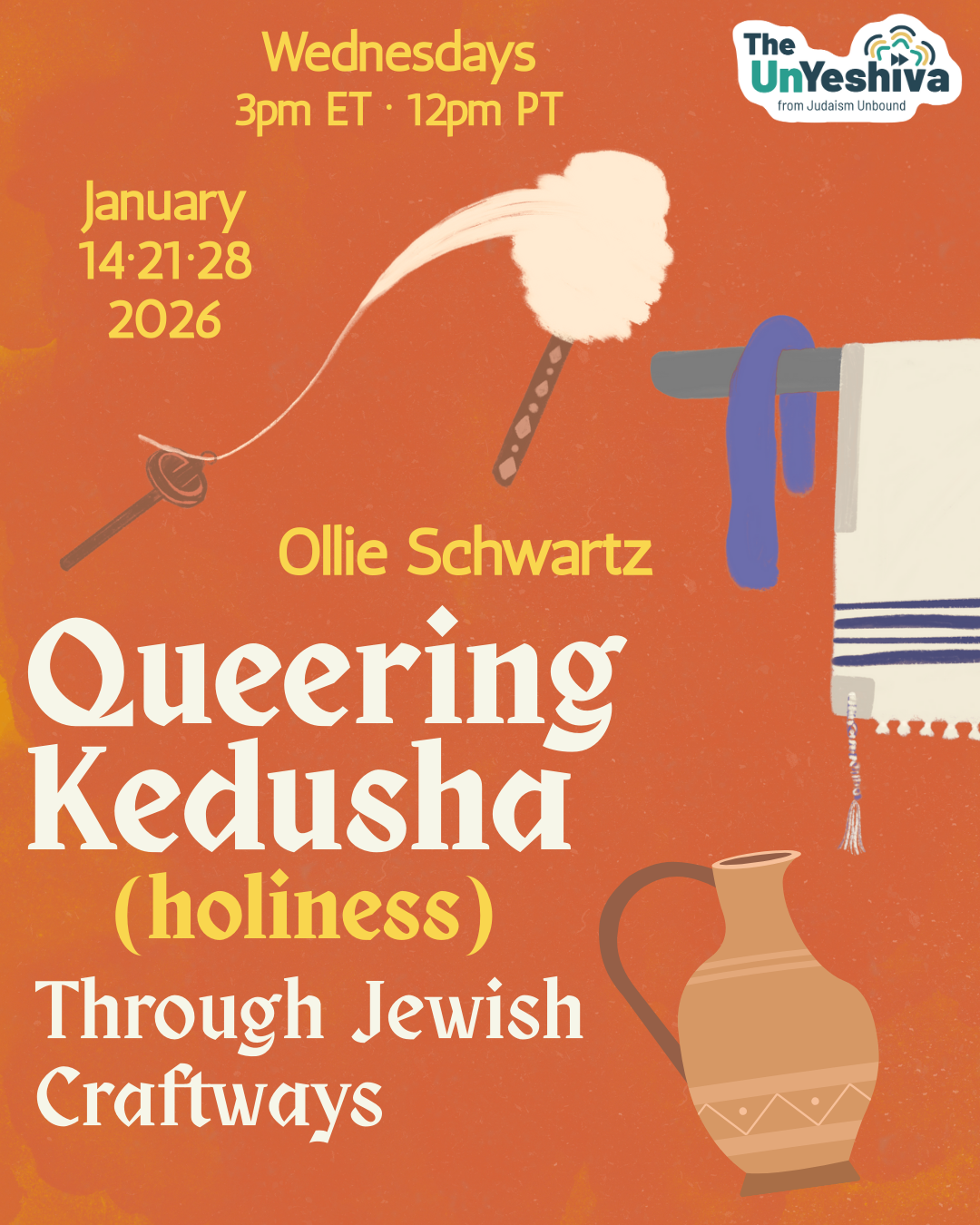 Image 1 of 2
 Image 2 of 2