
EPISODE 1: Belonging to Time
Show Notes
I received Kohenet smicha from The Kohenet Hebrew Priestess Institute in July 2017.
The chorus of voices affirming that I am a Kohenet was recorded during the ceremony.
The Torah reference about ceasing from work comes from Breishit 2:2.
My understanding of Jewish people as “people of the book, body, and earth” has been informed by a number of sources and teachers; notable among them is Rav Kohenet Taya Mâ.
Though I have come to understand that many somatic therapists and practitioners have written about the way that trauma can cause people to dissociate from their bodies, I learned it from a variety of sources and forums, none of which credited a source.
The Kabbalistic concept of the Four Worlds is outlined in greater depth here.
Octavia Raheem is an embodied practitioner and author who you can learn more about here.
Asher Yatzar by Dan Nichols
Helen Marie is a psychotherapist who you can learn more about here.
The story of Reb Zusha is paraphrased from Martin Buber's Tales of the Hasidim.
I learned the concept of makom kavuah (our fixed place) from Rabbi David Jaffe, Founder of Kirva, during a session about the Mussar concept of anavah (being right-sized).
This episode is brought to you by the Institute for Jewish Spirituality. Rest to Return exists because we believe slowing down is a spiritual act. IJS believes that too. For over two decades, IJS has been helping people go deeper, through Jewish mindfulness meditation, contemplative prayer, sacred text study, and embodied practice. Their offerings range from online courses and silent retreats to immersive cohort programs for seekers of all experience levels, clergy, and spiritual leaders who are ready to live and lead from a more grounded place. Kohenet Keshira haLev Fife is part of IJS’s core faculty, and the wisdom you'll hear in this series is very much in that spirit. If this podcast is stirring something in you, IJS is a place to go further. Explore their programs, and more ways to learn and practice with Keshira, at jewishspirituality.org, including:
View the latest offerings from IJS in our program catalog
Join Keshira on retreat this August: Returning Anew
Learn more about Keshira's latest class at IJS on Mindful Speech as a Spiritual Practice
Learn more about Shevet, IJS's community for younger adults (20s-30s)
IJS has several online free practices with Keshira and our other faculty including our live Daily Sit, our weekly Shevet Sit for younger adults (under 40), and monthly Affinity Sits for Jews of Color, LGBTQ+, and individuals with disabilities. Click here for more information.
Join our mailing list to be notified about our upcoming fall courses, including Keshira's Earth, Moon, Mindfulness year-long class.
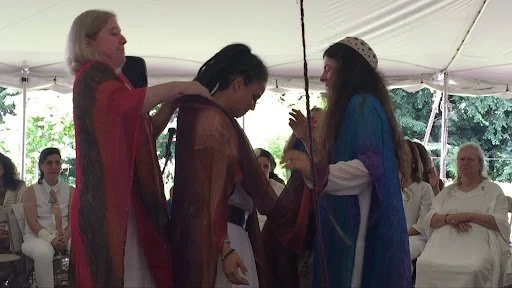
My Kohenet smicha ceremony
-
I remember it like it was yesterday - stepping into the sacred spiral, surrounded by community. Teachers, priestesses, family, friends, all there to witness the moment of smicha, ordination as a Kohenet. The feminised version of the Hebrew word, Kohen, Kohenet, means “Hebrew Priestess”. And I had been dreaming of this moment for years.
First, the giving of a Priestess title: Choveret chever v’Kohelet baMidbar: tier of magical knots and gatherer of people at the origin.
And then, kanfot - sacred garment - laid over my shoulders. Gentle hands at my back, over my head, holding my feet to the earth…
Mi-kedem—from before
Mi-l'mala—from above
Mi-l'mata—from below
And then voices rang out in chorus…from this moment forward, you are a Kohenet.
I took a deep breath as I opened to the Sacred energy that was coursing through me from all directions.
I felt myself stretch across time and space—connected to ancestors I'd never met, connected to the earth beneath me, connected to something vast and holy, not to be named but to be embodied.
I felt that I had received some kind of Divine mandate. Not more power. Not authority. Just a clearer sense of purpose.
I left that experience feeling simultaneously energized...and utterly exhausted.
I knew that in order to sustain, I would need to re-evaluate the relationship between my newfound sacred purpose and deep rest.
Because here's the thing: I had just committed to a life of Divine service. To teaching, to leading, to showing up for my community. And I could already feel how much that was going to ask of me.
Welcome to Rest to Return, a podcast for a restless world. I’m Kohenet Keshira haLev Fife and I’m your host. This series is rooted in Shabbat, an ancient Jewish practice that teaches us how to belong to time. Here, rest is a sacred rhythm woven into who we are.
We begin by gathering around a single question: What do we need in order to sustain our sacred purpose?
This is an invitation to return. Sacred time starts now.
When I ask myself the question, "What do I need in order to sustain my sacred purpose?", the first thing that comes to mind is rest.
According to some etymological accounts, the word “rest” came from “restan”, from the same root which means "league" or "mile", a measure of distance.
What’s the connection? It comes from the days when people used to travel much more slowly than we do in modern times, walking or riding on horseback. Back then, “rest” was defined as the distance that one would travel before stopping to restore.
So what happens when the journey is our lives? How do we measure the distance when we might not be physically moving at all? How do we know when to stop and restore?
According to the Torah, in Breishit (2:2),
וַיְכַ֤ל אֱלֹהִים֙ בַּיּ֣וֹם הַשְּׁבִיעִ֔י מְלַאכְתּ֖וֹ אֲשֶׁ֣ר עָשָׂ֑ה וַיִּשְׁבֹּת֙ בַּיּ֣וֹם הַשְּׁבִיעִ֔י מִכׇּל־מְלַאכְתּ֖וֹ אֲשֶׁ֥ר עָשָֽׂה׃
On the seventh day, Creator finished the work that had been undertaken: They ceased on the seventh day from doing any of the work.
From this verse, Jewish tradition derives the practice of ceasing work and resting on the 7th day of each week, on Shabbat.
What a potent practice for people - as individuals, as families, and as communities - to carry an ethos that values rest. Jewish law offers a specific prescription of how rest is defined on Shabbat; what activities are prohibited, what rituals are required. And there is beauty and power in that structure which has sustained the Jewish people for millennia.
At the same time, for many of us, our practices come from the confluence of tradition and present-moment resonance, even if we don’t realise it. We try to hold the ancient gems of Jewish tradition while honouring that we must also make space for what feels most aligned given the modern context, and our desire to be responsive to our lives as they unfold. Different moments in our lives demand different ways of showing up. So we hold both with care: the wisdom of Jewish tradition and the wisdom of our own bodies in any given moment.
When I was a child, I was told that the Jews are “the people of the book”. And it was easy to believe because there was evidence everywhere. Many Jewish homes that I visited featured packed bookcases, the Rabbi’s study was lined with volumes from floor to ceiling, and the only Jewish store that existed in my hometown of Pittsburgh was at least half full of books. Jewish people across time and space have authored and recorded so much material. We have a tradition of scholarship and more continues to pour forth in every generation; our collective wisdom is rich, and beautiful, and worthy of celebration.
However, what my teachers didn’t tell me was that it was not always this way. In fact, the first Jewish ancestors originated as “people of the earth”: they were deeply connected to season and cycle, agriculturally-grounded, making ritual with earth-based material, and interacting with the elements at every turn. From the fires on the mountain to the parting of the sea, elemental Divine presence is woven throughout the Jewish origin story.
And from the early days, we have been a people on the move, so much so that, in Torah times, we carried a mishkan, a portable sanctuary that accompanied us through the wilderness as a home where the Divine could dwell no matter where we were.
In every generation, our people have moved and settled, making home in various places, always bringing our sacredness with us. Sometimes, we kept going because we were pursuing a destination or because we were fleeing from pogroms. Other times, it was because we were gathering courage to manifest our dreams of freedom. And, when our holy Temple was destroyed, we found ourselves disconnected from place, though never from the earth.
So we learned to carry our Judaism with us. The locus of our sacredness became oriented in the body. We wore sacred garments, ate matzah, took in the essence of havdalah spices, immersed in water, dwelt in our sukkot, physically wrapped ourselves in words of Torah. Our very bodies became a mishkan of sorts as we learned that they were holy and that they could be our spiritual homes.
Over time, various traumas - chief among them the Shoah - left us feeling that it was not safe to be in our bodies…and so we took refuge in our heads. In many cases, what we learned was that it was safer to blend in, to not look so different, to assimilate into the wider society, so we began to carry our Judaism in our minds. In our pursuit of safety, acceptance, and prosperity - all things worthy of seeking - we didn’t realise the cost. Moving into our heads caused disconnection from the body and, worse yet, we experienced a sort of cultural amnesia about the sacred role that the body had played for so many generations.
What emerged was a “heady” sort of Judaism where we strengthened our focus on intellectual wisdom, on the places where we could preserve and share knowledge. And so we became the “people of the book”.
Being people of the book has invited us to be part of a Jewish conversation that has spanned generations. At the same time, it was gratifying for me to remember the ways that my ancestors were also people of the land, people of the body, and people on the move.
When we consider our own Jewishness in this framework, we might recognise that, in order to rest most deeply, we must reclaim the wholeness that comes from re-centering the body. It is simply not possible to rest only in our heads because the body is fundamental to how we exist. The Kabbalists teach us that the realms of body, mind, heart, and spirit are all interconnected and that what we experience in one of them reverberates through our entire being. Something powerful happens when we bring ourselves to rest - slowing down our bodies or bringing them to stillness, releasing the mental load and allowing our minds to settle, giving ourselves permission to set down the burdens of our hearts.
Regardless of what might be tiring us, it’s through our awareness of what’s registering in our bodies that we know how and when to rest.
Author and embodied practitioner, Octavia Raheem describes it this way: “rest is limiting sensory input in a way that allows your parasympathetic nervous system to come online and work for you.”
This wisdom acknowledges that we experience the world through our senses, through our bodies. When we’re overstimulated either because of prolonged activity or the environments we’re in, it has an impact on our nervous systems. By limiting what we’re exposed to - sounds, smells, tastes and textures, visual stimuli, anything that amps us up - we can allow for our systems to dip into a state of being that invites revitalisation.
When rest takes up residence in the body, it radiates outward, inviting spaciousness to heart and mind. And though Judaism has become intellectualised over time, this is very much in accordance with Jewish wisdom, which has never stopped acknowledging the body as central.
Those who recite traditional prayers each morning, uplift praise and gratitude that our bodies are in working order.
Part of the power of this prayer is that it acknowledges that we need our bodies in order to live and to do our sacred work…and that our bodies don’t need to be perfect; that no body is more or less holy than any other.
This is because each of us is created b'tzelem Elohim, in the Divine image. Our very aliveness is evidence of divinity coursing through us. It's a subtle acknowledgement that our existence matters. That even as each of us has different gifts and talents, each of us also has different needs and that, therefore, we may also need different kinds of rest.
Of course, rest is not just sleep. Rest is not just leisure. It's an alchemy of pace and activity that brings us to a place of feeling more easeful, clear, and present.
Psychotherapist Helen Marie teaches that “Slowing down is literally how your nervous system heals.”
She’s suggesting that by slowing our pace, by letting go of rushing, by giving ourselves time to breathe, we create the conditions for healing and restoration.
Rest clearly does something for us but we’ve been misled into thinking that rest is primarily utilitarian; that the point of rest is to refill our tank in order to keep going. Functionally, this may be true but it can also lead to burnout because it’s missing a critical awareness: rest reconnects us with our deepest selves.
At its core, rest is about creating a pathway of return so that we don’t lose ourselves in the busyness that pervades our world. In this way, we could think of rest as an affirmation of who we are, taking care of ourselves in a way that allows us to be most aligned and clear in our choices and in our lives.
We must transform our relationship with rest so that we understand it as a portal which brings us back to ourselves. In making room for stillness, the parts that have fallen behind - or the parts that have stayed back in protest of our pace - are able to return. They come back because we finally waited, and because in waiting, we showed them that they are worth cherishing.
The story of Zusha recalls that a revered Chassidic master lay on his deathbed, riddled with sadness and worry. His students were puzzled, for he had performed so many mitzvot and he had spent his life striving to emulate those who he most admired, like Moses and King David.
“I’m afraid,” he admitted, ”that when my time comes, the Holy One will not ask me “why weren’t you more like Moses?” or “why weren’t you more like King David?” but rather “Zusha, why weren’t you more like Zusha?”
In our world, it’s so easy to be fooled by the idea that we’ll be more worthy, more valuable, more loveable if we can be more like those who are celebrated. The practice of rest helps to unwind that mentality, reminding us that our sacred purpose is to be the truest versions of ourselves, to fully inhabit our makom kavuah (our fixed place) and to do the work that is uniquely ours to do.
When we do this in a fulsome way, not only do we embrace our sacred purpose, we inherently give ourselves permission to let go of what isn’t ours. By focusing on our own part, we take our place within the collective work of our times.
When we do this work in concert with one another, we also weave community, bringing people together, tending our relationships with care, and acting in reciprocity. In this way, we make manifest a cosmic web that can hold and sustain us, something far greater than us that ensures that even if we falter, we won't fall too far.
Encouraging one another to rest, and supporting each other as we do, is part of this work too. The more we do this - weaving and resting, weaving and resting, we deepen in humility to contribute when it’s our turn and humble ourselves to others’ contributions in kind. This alone is a form of weaving which strengthens the fibres of our web, while also cultivating our ability to trust.
The more we do this, the more we might come to trust in the parts of the web that are beyond what we can perceive. Whether that means mutual aid from a distance, or what we need serendipitously appearing, we might get the sense that things are falling into place because of efforts beyond our own. In short, loosening our grip on individualism and leaning into trust makes way for more heldness.
Traditional Shabbat practice offers specific prohibitions against work and specific rituals to beautify sacred time. By freeing us from having to do many of the tasks that we do throughout the week, the structure creates a container for rest, for remembering, for reconnecting with who we are.
There is another equally worthy way: we could start internally, attuning to the resonance in our bones, checking in with the quality of our breath. Slowing ourselves down from the inside out so that no matter the circumstances, we create an anchor which guides us back to a place of rest, release, and return to our most regulated and aligned selves.
We need both: a Shabbat practice and a rest practice; they serve two different purposes but, when combined, they can help us to remember - to re-member - ourselves back to wholeness.
Our practice for this week is an embodied affirmation practice, taking three minutes to rest while bringing consciousness to two truths: first, your purpose is sacred. And second, you are worthy of rest.
If coming to a seated position is accessible, you can bring the motion into your body by rocking forward and backward with the music, as you speak or think these affirmations: my purpose is sacred. And I am worthy of rest.
Rock forward with the awareness that your purpose is sacred, rock back with the awareness that you are worthy of rest.
Any time your mind wanders, you can gently return to these words: my purpose is sacred. I am worthy of rest.
[Meditative Version of Lay It Down, Let it Go]
Indeed, your purpose is sacred, dear listener, and you are deeply worthy of rest…
We began with the question “what do I need in order to sustain a life of sacred purpose?” And the answer that came was rest.
Now we know that rest is not just ceasing, not just stopping. Rest is slowing down. Rest is healing. Rest is returning - to the body, to the earth, to the essence of who we are.
Rest is the invitation to lean back and ride on the wing of Shekhinah. It’s the cosmic web catching us when we finally let go. It’s the reclamation of our bodies and beings as inherently Divine.
You are worthy of rest. Not because you've worked hard enough. Not because you’re going to work hard. You deserve it because you are alive. Because you are part of creation. Because your body - miraculous, imperfect, and beautiful - needs it.
Because you have a sacred purpose. And because the world needs you to do that work.
Join us next time as we delve into the question of “what is work?” and we consider work and rest in dynamic tension.
Rest well, dear listener. And join us next time…
Miriam Terlinchamp: Gratitude to Lippman Kanfer Foundation for Living Torah for making Rest to Return possible. Rest to Return is a production of the Institute for the Next Jewish Future and part of the family of podcasts of Judaism Unbound. Hosted by Keshira haLev Fife, directed by Joey Taylor, produced at Monastery Studios (which sits on the land of the Shawnee, Delaware, Potawatomi, Miami, Wyandot, Seneca, Ojibwe, Ottawa, and the Wapakoneta), sound engineering by Justin Newton, original music by Keshira haLev Fife, arrangements by Ric Hordinski and art by Katie Kaestner.