
Everyday Mystics Episode 3: It Would Have Been Enough
What happens when the lessons that carried you through life suddenly aren't enough? For Todd an unexpected crisis sets him on a journey where he begins to discover new ways of understanding love, loss, and the sacred. In the third episode of Everyday Mystics, a story of grief, gratitude, and mysterious encounter invites us to wonder whether the people we love are ever really as far away as they seem.
SHOW NOTES
[1] We begin the episode with a reference to Moses and the burning bush. The moment where he turns and sees that is burning but not consumed. Exodus 3:2
[2] Todd mentions the works of Austrian-Israeli philosopher, Martin Buber. Buber is best known for his concept between the Divine and Humanity, I and Thou. The existential framing of that meaning is defined by how we relate to one another.
[3] Dayenu, a 9th century song that translates to “it would have been enough.” There are 15 stanzas rejoicing in the wonders that blessed the Israelite people (Exodus from Egypt, the gift of Shabbat, the Torah…ect). It is the most popular song to sing during a Passover Seder. Colloquillaly, Dayenu is used in an opposite way - more like, Enough already! Rather than the intent of the song as one immersed in uncountable blessings.
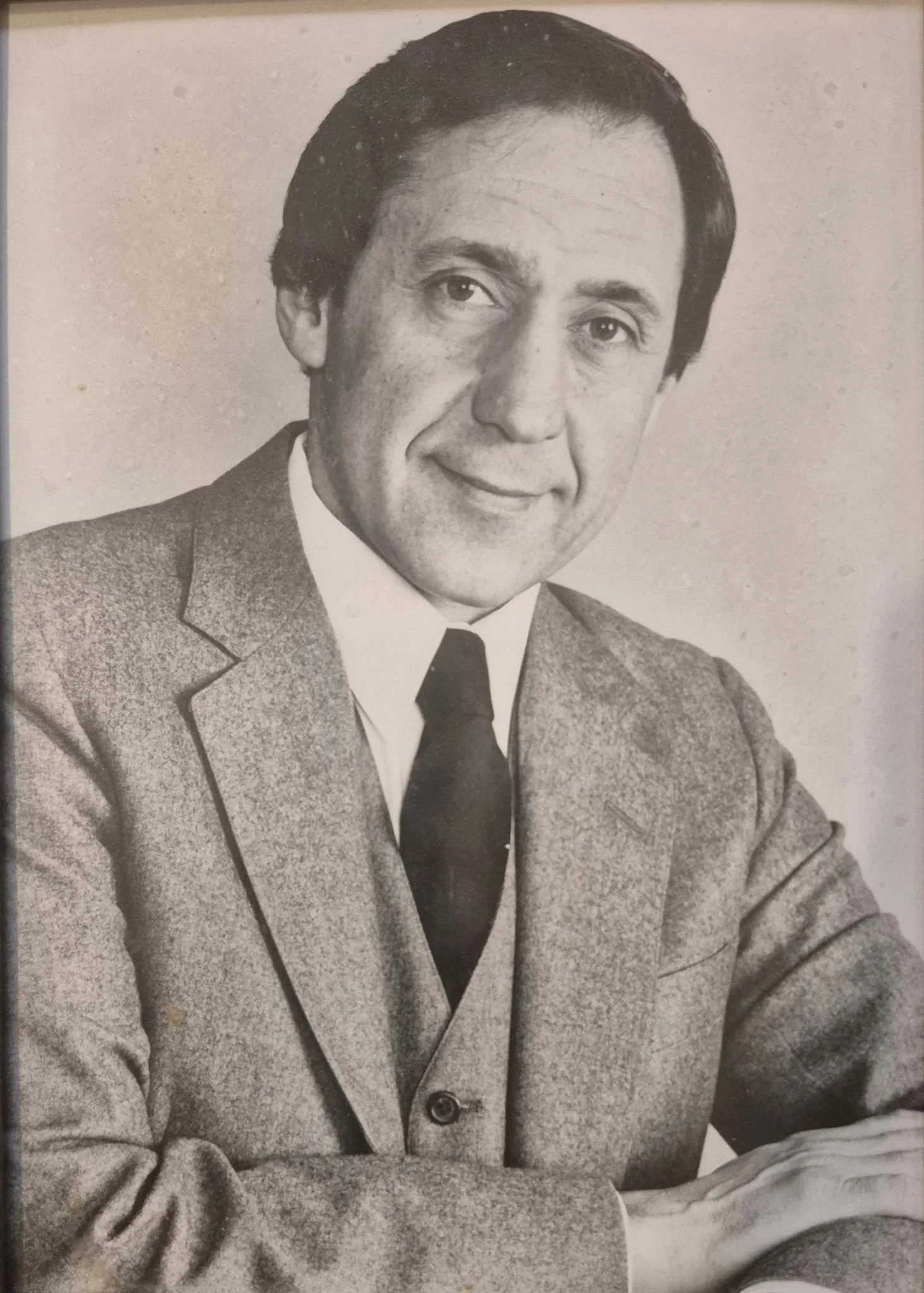
[4] Photo to the left if from Todd’s desk of his father, Lewis Brecher z”l.
-
Miriam: In the biblical stories of Moses and his call, we understand that Moses didn't stumble into the sacred — he turned toward it. Vayar, vayisov lirot: he saw, and he turned aside to look. Today's story turns on another word from that same tradition and story in Exodus: dayenu, enough. It's the word Todd's father taught him without ever really saying it out loud — a look, a shift in tone, the signal that grief had run its course and life needs you back. For most of Todd's life, that was the whole toolkit. Then came a loss the word “enough” couldn't cover, and Todd had to learn the hard way, how to turn.
Welcome to Everyday Mystics, where we believe that the story of Moses awakening to his call through a burning bush that could not be consumed, is not just a one of a kind, once upon a time story, but rather a map for our own lives. Each of us has a story or stories of untold wonder that break and shape the humans we become. We call these people, everyday mystics. In this podcast we tell stories of Jewish people who stumble across burning bushes and come away seeing Judaism differently. I’m Miriam Terlinchamp, and these are stories of the moments when the everyday becomes sacred, the familiar becomes mysterious, and Judaism becomes beautifully unbound.
When Todd was a boy, his dad had a happy place. Getting there was easy enough. You needed a golf course, a set of clubs, and an afternoon. Staying happy once you got there, well that was harder. Especially if you were Todd, and every bad shot felt like it might cost you something more than a stroke.
TODD: Growing up, um, one of the things that I really wanted to bond with my dad with was over, over sports. He was a really good athlete all his life. He played baseball in college, and growing up he was a big tennis player and particularly golfer. Golf was, like, his real happy place.
Miriam: Todd wanted in on that happy place. He wanted to feel that way about sports - the escapism, the passion, the guarantee of fully, embodied happiness. But it wasn’t that easy for Todd.
TODD: I always really struggled with athletics because, I had a lazy eye when I was born, really bad. I had surgery when I was two and a half, but never really quite, uh, got fixed. Um, and also I always like to say I'm 5'10" and, uh, you know, my hands are, my hands are pretty small for 5'10", and my feet as well. Like, I'm only, like, a size nine. And so I always say, "Gee," I always have trouble with hand-eye coordination. My handwriting is really bad. You know, I'm a sloppy eater my wife would say. So it was always a struggle for me playing sports and it, and it was hard emotionally because when I was playing team sports, I would be, you know, one of the worst at it.
Miriam: Sometimes his dad coached his teams. Imagine wanting to impress the best athlete you know, while he watches you be one of the worst. By junior high, Todd had given up team sports. Golf offered another possibility: time with his father, without a whole team depending on him. He practiced. He improved. And at fifteen or sixteen, he was finally getting somewhere. Until he hit a bad shot.
TODD: And I, I just remember one time in particular, we were out playing. Often we would go, the two of us, so you get matched up, uh, with a coup- with other people to play with you, and this was one of those times. And, I just got so upset that I just, like, took one of my clubs and I just, like, f- you know, just kind of almost like a Frisbee throw as far as I could into the woods, and it, like, hit a tree and bounced off. And my dad was someone who always stayed very calm. Um, certainly externally. You very rarely saw him lose his temper.
Miriam: Todd remembers the look his father gave him. There were other people playing with them that day, and Todd thought his dad was embarrassed. This was supposed to be their time together. Now he had a club somewhere in the woods, and the feeling that he had let his father down.
TODD: Not that I ever questioned his affection or his love. But he showed it really by being kind of there for you, uh, when you needed him, and, and being, he was a really, really good listener, and he was tolerant sort of to a certain point of, of kind of, you know, whether it was as a kid, and, and this really was through all of life, if you're having a problem or having an issue, and if I was getting really upset about it, he was really good at letting me express my emotions and get to a certain point, but then there'd be a point where you'd just get this slight change of his tone of voice or if you were in person, um, you know, you'd see something in his face that was like, "Enough."
Miriam: That was the arrangement. Todd could fall apart for a while. His dad would listen. Then came the signal: enough. You can have your feelings, but at some point, enough! dayenu! You need to keep going. His father had a word for this process, even though he didn’t say it in the hebrew - Dayenu. Enough already. It's the translation of dayenu that many of us learn first — the impatient one, the one that shuts a feeling down so life can keep moving. It would be years before Todd learned there's another way to hear that word. His father understood something that Todd couldn’t at that age. He knew that perseverance wasn’t a choice, but a requirement for life.
TODD: In fact, you know, my dad didn't tell me this till maybe I was, like, in my 30s I think, but when he was younger, he, he definitely had some of his own, uh, trouble controlling his emotions, and he told me a story once about when he was in 20s and playing golf and, and he got really, really frustrated with how it was going one day and, like, picked up his entire golf bag and, like, threw it in a lake. Um, I was like, "Wait, that's worse than anything I ever did."
Miriam: An entire bag. Todd had thrown a single club. There was more of his father in him than either of them had said. The golf course, regardless of how well they played, became their happy place. For decades, when Todd had a real problem, at work, at home, in his own life, they’d hit the golf course. For good or for bad, his dad was the person he called. That relationship gave him somewhere to take his troubles. His father was his moral guide, the person he brought his heartfelt questions about life to, whereas Todd’s religion, Judaism, occupied a different part of his life. Similar to other suburban east coast progressive Jewish families, Todd was raised to understand Judaism through the lens of community. It was a religion of social connection and social change. They went to a Reform temple. There were bar and bat mitzvahs. There was Jewish history, community, and a concern for social justice. His father wanted those things for his children, even as he resisted religious observance himself. It was a community rich in human connection, but not the space they were taught to search for meaningful responses to life’s questions. Looking back, Todd found a phrase for what his own Jewish education had been missing.
TODD: So, uh, I saw this recently. Someone described this type of Jewish education that we've had, you know, um, and in, I- as sort of skim milk Judaism in that, um, the, the, the real focus of the, the education you get from, you know, starting at three years old till the time you're 12 or 13 is like, "We gotta prepare you for the bar or bat mitzvah." So it means, you know, we spend a bunch of time kind of learning Hebrew in the sense of learning prayers and reciting them and repeating them, and so that you're gonna get to a point where you can, you can, you can, you can do your bat mitzvah or your bar mitzvah, but you don't actually try to learn the language.
Miriam: Todd learned to recite the prayers. But he had no idea what they meant. And it felt, at the time, like the Jewish environment he was raised in was also uninterested in helping him discover what those prayers might have to do with the life he was actually living: the frustration, the longing, the difficulty of being himself. Religion was for community, not for moral depth.
TODD: Yeah, I'd say my dad, you know, um, had a lot of deep love between us. Uh, but certainly in dealing with any type of internal problems or crisis, it never, I think, would've occurred to him or to sort of say like, "Let's talk about how Judaism can, can help us here." That was just not a thing.
Miriam: In 2015, Todd was forty-six. His father was eighty-one. Todd believed there was plenty of time ahead for them. In some ways, his father was invincible - having survived cancer twice, he watched his diet, and stayed in great physical shape. And he stayed committed to those happy place tee times. Then his father got sick on a Friday. By Sunday morning, Todd’s sister was calling.
TODD: My mom took him into the hospital, uh, and he just rapidly deteriorated. They could tell he had some kind of infection. They didn't know what, and by sort of Saturday night, they had had to put him into, like, an induced coma and basically on sort of life support. And the message was, "He's likely not gonna survive much longer." Uh, and like a really, like, "You have to get down here right now because this, this is a matter of days, you know, not any more than that." So, you know, just from going up and waking on a Sunday morning, I'm sure my, you know, I probably had activities that I was supposed to do with my kids that day, and all of a sudden you're just in this complete shock.
Miriam: The future contracted to a matter of days.
TODD: And it was just, like, felt so unfair and angry. A- and I remember when, you know, um, I went to the airport with my sister and we got on the plane, and I just looked across the aisle and there was a man who probably was in his, I would say, late 70s, and he was, uh, pretty overweight, and he was... had bought some, like, you know unhealthy food, probably fast food, uh, before he got on the plane, and he was sitting eating it on the plane. And I just remember looking across, and then sort of throughout the flight looking across and being like, "What is going on here? How is my dad, who, you know, did everything he could to be healthy and was healthy as of two days ago, we thought, uh, is now about to die, and people who don't take care of themselves are going to, to live?"
Miriam: Todd was looking for some order to what was happening. Someone to blame. A reason to continue to believe that if you do everything right, all will be well. Afterall, his father had taken care of himself. Had made all the right choices. Been good, done good in the world, for his family and for himself. Surely that ought to count for something. The stranger across the aisle was alive, eating his food, going somewhere while Todd’s dad was dying. This is what happens when the floor drops away, you spin, looking for something to turn toward, and for a while there's nothing there.
TODD: it was a very rough experience. I, I really, I was able to get to the hospital on Sunday, wasn't able to communicate or talk to him in any way. And by Monday, they were basically saying, you know, "It's, there's nothing we can do, and we should just let him go," and, you know, we had to do that.
Miriam: He made it just in time to see his father in the hospital. But there was never a last conversation, a chance at a real goodbye. And the one person he could bring all this pain and confusion to, was now ripped from his life. But life still had to go on. There were still people who needed Todd. His mother. His sisters. His children. Todd tried to hold himself together. But there was no one to listen and tell him “enough”. He felt like he was going to lose it. That night, he stepped outside into his parents’ driveway.
TODD: It was nighttime. I remember, I remember it being a pretty clear night. There was like, you could see some stars. Um, and it was q- my parents lived on a little bit of sort of a cul-de-sac in their development. There was no one around, and all of a sudden, just this anger just kind of erupted in me, and I just had to voice it at some way, and the way I did was by sort of cursing the universe. And like I said, I'm sure I was saying things like, "God, how are you letting this happen? What's wrong with you? Why should this be happening? It's totally unfair," and probably angry and, you know, crying. Just a very, very visceral moment where you have all of this emotion, uh, and all of this deep sadness and anger and, you know, no way to process it, and no way to deal with it, so it just comes out, you know, as this stream of, you know, like almost vomiting up your emotions I guess is the way to say it. And then, you know, after that ends, feeling just very empty and lost. Um, and then kind of like, "Well, now I have to go inside and, you know, kind of have my shit together again." So, you know, there was no sort of like, "Hmm," like I have some tools to deal with this really. I just, I just have to deal with it somehow.
Miriam: For years, Todd had known what to do when his feelings became too much: call his father. Now the thing he most needed to talk to his father about was his father’s death. And the instruction he had learned so well, to pull himself together and carry on, could get him back through the front door but it could not tell him what to do with the absence on the other side of it.
Miriam: As time passed, Todd looked for help. Eventually he turns toward Judaism not away from it, and not back to the version he'd inherited, but toward something he'd have to go looking for on his own.
TODD: So while I probably talked to him once or twice, it didn't really lead me anywhere. So, you know, that was the point where I said, "Well, you know, let me-- I, I feel I need something spiritual, something faith-based to help me through this, and maybe I can, can find that in Judaism."
Miriam: Todd is a life long learner, and a voracious reader. So he started reading. And then he kept going: books, teachers, communities, years of study and practice. He began discovering forms of Jewish life he had barely known existed. The tradition he had inherited was larger than the version he had been given. One opening came through the philosopher Martin Buber.
Todd: The first time I started to have some belief in any kind of, in any spiritual way was reading Martin Buber talking about that God is in a, when you have a deep connection with another person, that what's, there's an energy between you, and that's God. I was like, "Oh, that sounds really cool and interesting, and I can believe that." And then I, that was my door into Jewish mysticism, and it was years of study and thinking and trying to start doing practice, um, that got me there. But I'm just at a point now where I'm open to anything that I wouldn't have been open to.
Miriam: A connection between people could become a place to encounter God. Todd could begin there. Over time, Jewish mysticism gave him ways to imagine a reality larger than what he could see. He came to understand himself as part of something shared, something that did not begin and end with his separate life. That did not supply a reason his dad had died. It did not justify or explain away his pain. He no longer believed in a God directing events that way. Somehow, it all became bigger than cause and effect, more, about a connected oneness.
TODD: And so this was just a thing that happened. Um, and the meaning, I guess, is in how you react to it
Miriam: For Todd, this also opened a possibility about death: that the end of a body might not exhaust everything a person is. He began experiencing conversations with his father, in dreams and in his waking life. He knew those conversations took shape in his own words and imagination. They also felt real to him.
TODD: and that helped me feel good and right about having an ongoing dialogue with my father. which is still, because it has to be expressed in the form of the only way we have to express these things is human words and emotions. It takes the form of him talking to me or my imagining this conversation with him, but it is something that has become very real to me and, and very helpful to me and, um, on a lot of levels, just sort of, um, but having a real still-- I do still feel a real personal connection, um, that is there and that is i-in all kinds of ways.
Miriam: And then there were the birds.
TODD: So ever since, you know, so my, my father passed away in 2015, my mother passed away in 2020, and ever since that time, both me and my sisters have had these experiences of, like, small kind of black birds showing up in places, um, that seem to have significance in some way or another. Um, and yeah, I had a very strong experience with that recently.
Miriam: Years after losing his father, Todd took up running, partly inspired by his daughter. The boy who had struggled to keep up in sports was now a man finding something he enjoyed. One day a few seasons into his new running habit, on a visit to the Jersey Shore with his sister and one of his daughters, Todd decided to see how far he could go.
TODD: I was gonna go out for a run, and, um, in particular I was like, "I'm gonna try to run longer than I've ever run. I'm gonna try to run..." You know, at that point I'd run maybe four miles was the longest, so I'm gonna try to run six or seven. And just as I started to run, um, within a few minutes, uh, all of a sudden I feel, like, a tap on my head. And I look up and there's a black bird that is flying away, and clearly had just tapped me on the head, and then went and, you know, sat on, like, a telephone wire. And immediately I was like, "That's Dad." That's Dad saying, "Good for you. You finally..." You know. My dad would often show affection by, like, kind of making jokes, and was like, "Oh, you finally found a sport that you can do and that you can enjoy." And so that was just really cool and, again, something that I, you know, believe that, you know, whate- that there could be sort of, like, some entity that is, either is or contains my father as part of a larger thing that, you know, sent a signal to me and a little, a little tap on the head, a little tap, you know, a little pat on the back.
Miriam: The recognition arrived with a joke. Of course it did. Todd knew this way of being loved: the teasing, the affection tucked inside it. He had spent so much of his childhood trying to find something he could share with his father. Now, out running, he felt his father sharing something with him. A small touch. A familiar voice. Good for you.
Todd leaves room for what he does not know about that moment. He talks about a signal, a possibility, something larger that might contain his father. He doesn’t feel a need to define it. What he can tell us is how it felt to receive it. The relationship he thought he had lost could still surprise him. It could even change. Dayenu. This could be enough
here's the Dayenu most of us grew up with, enough already, let's eat. And there's an older one, the one the song is actually built on: it would have been enough. Every line counts a single gift and says that gift alone would have justified the thanks. A tap on the head from a bird wasn't Todd shutting a feeling down. It was Todd counting a blessing. It would have been enough to still feel his father's presence at all. The joke on top of it that was abundance stacked on abundance.
TODD: it is, it's more about a sharing of just everything, um, and much less about, "Oh, I have this. I'm really upset about this. Tell me to stop being upset," you know? That's just not... So, yeah.
Miriam: There is a photograph on Todd’s desk now, his dad in his forties. Todd looks at it as he works and thinks. Sometimes it helps him enter that conversation again.
TODD: So naturally sort of when I start to think about things, he's right there, and I look at him, and, you know, that's a trigger into this other s- you know, space, other, this other type of consciousness where I can feel a real connection. So I think it is something that, you know, that visual marker is kind of this door that's always open
Miriam: Once, being with his father meant getting out onto the golf course. He could spend an afternoon beside him, trying, getting frustrated, trying again. Todd still wants that closeness. He has found a Jewish life with room for the wanting, with enough spaciousness to know that life isn’t a big calculation, but rather a web of experiences that connect us to the greater whole. He makes room now for experiences he once would have dismissed.
Once upon a time, that tap on the head would have been explained away by something practical. But now, the gift of expansion, allowed him to feel the impact of the tap, to hear the voice of his father, and enter into the feeling that the distance between their souls isn’t as vast as life and death might have you believe.
When the floor drops from us, we are offered a choice - return to the way you’ve always seen and approached the world, to the “supposed to be’s” and the “because I earned it” and “Planned it” calcifying in our approach to life. Or we can allow the experience to change us, unravelling the “shoulds” and “supposed to” and the grand plans and instead revealing a future of mystery and meaning, far greater than we could have ever imagined.
This is what it means to turn — not once, the way Moses did, but again and again, every time the floor drops out. And this is what it means to say dayenu — not enough already, but in gratitude: it would have been enough. It would have been enough to have had him at all.
Miriam: Big thanks to Todd for sharing his story. Todd Brecher is the Director of Operations & Strategy at Judaism Unbound. Thank you to our generous sponsors, Barbara and Mathew Loonin for making Everyday Mystics possible. Everyday Mystics is a production of the Institute for the Next Jewish Future, and part of the family of podcasts of Judaism Unbound, hosted by me, Miriam Terlinchamp, produced by Joey Taylor, sound engineering by Justin Newton, original podcast music by Ric Hordinski and art by Katie Kaestner. Check the show notes for more information on Todd and, as always, we'd love to hear from you. Please email us at hello@judaismunbound.com if you have an Everyday Mystics story that you’d like to share.